1. You are obsessed with Warren Buffett
Do you watch every interview on CNBC that Buffett does?
Do you read every one of Berkshire’s shareholder letters, attend the annual meetings because you’re a shareholder, or quote Buffett on social media?
An obsession with Mr. Buffett is one big sign that you’re probably a value investor yourself.
2. You love stocks trading at 52-week lows
Benjamin Graham, the father of value investing, has told investors to look for stocks trading on new 52-week lows.
If you enjoy looking at those stocks because you’re thinking you’re getting a bargain, you could be a value investor.
3. You buy and hold your stocks
Buffett has owned some of his stocks for decades. Have you? If so, you may also be a value investor.
4. You love “boring” companies
Buffett has gotten rich owning some of the more “boring” types of companies including industrials, railroads, energy and, famously, insurance.
5. You never buy companies with negative earnings
If you don’t understand what all the fuss is about with Uber or Lyft, both of which don’t have positive earnings, you may be a value investor.
Sunday, October 20, 2019

Tuesday, October 08, 2019
major selloff predicted
The technical analysis that correctly called the market bottom in December is now calling a top in the S&P 500, CNBC's Jim Cramer said Tuesday.
The "Mad Money" host said a colleague of his at RealMoney.com is warning that "we're really cruising for a bruising" beyond the 1.56% decline Tuesday by the index.
Bob Moreno, chartist at RightViewTrading.com who projected in February that the market had more room to run, warns of a possible plummet in the large-cap index.
"Now those same charts tell Moreno that we're approaching an important moment and he's predicting a major sell-off from these levels, a 10% decline in the S&P," Cramer said.
That would bring the S&P below 2,620 from its 2,893.06 Tuesday close.
Since its low following the major December sell-off, the S&P 500 has gained about 27%. The index made a series of higher highs and higher lows during that expansion, but Moreno is convinced that momentum was disrupted in September when it produced a lower high, Cramer explained perusing the weekly chart of the S&P 500.
According to FactSet, the S&P 500 posted a closing high of 3,025.86 in late July and failed to break past 3,010 in September, a potential peak. Moreno, Cramer said, determined that to be a "double top," which is a bearish technical reversal pattern.
"Moreno believes the S&P is going to test its floor of support again, only this time that floor is at 2,825," Cramer said. "But if it fails, and he thinks it will, another floor at 2,725. That's where the S&P bottomed in March and June."
"Unfortunately, he doesn't see that trading floor ... holding either," Cramer said. "If the S&P breaks down from the current consolidation pattern, we could have not a little but a lot more downside."
There are more bearish indicators in Moreno's analysis. He notes the Moving Average Convergence Divergence indicator had a bearish crossover, which means momentum is slowing, and the Chaikin Oscillator supply/demand indicator dropped below its center line, which means money flow is negative, Cramer said.
"He's hoping the S&P 500 can find a floor at the 2,600 level. ... That's still a long way from a retest of last December's lows, but it's pretty horrible," he said. If the floor at 2,600 fails, Moreno "did say when we talked to him that if this fails, we could revisit [the December] level."
Chartists analyze past price action in stocks to forecast future price direction.
"Do I agree? Moreno's views echo my own for vast swathes of the market, but as someone who likes individual stocks, I'm ready for chance to buy best-of-breed names at bargain basement prices," Cramer said.
***
So he's predicting a floor at 2825, another floor at 2725, and another floor at 2600. Then I guess 2350 which is where the December low was. Well, that narrows it down...
I'd be looking to buy at each floor because nobody really knows which floor is actually going to hold.
***
Looking at the chart, I'd be looking to buy at around 2850 which is near the August bottom and the 200-day MA. Then I'd look to buy at around 2750 which is near the beginning of June low. Then maybe 2650 which is around the Oct/Nov 2018 lows. Then around 2400 as it approaches the December low. Maybe one of those will prove to be the bottom.
The "Mad Money" host said a colleague of his at RealMoney.com is warning that "we're really cruising for a bruising" beyond the 1.56% decline Tuesday by the index.
Bob Moreno, chartist at RightViewTrading.com who projected in February that the market had more room to run, warns of a possible plummet in the large-cap index.
"Now those same charts tell Moreno that we're approaching an important moment and he's predicting a major sell-off from these levels, a 10% decline in the S&P," Cramer said.
That would bring the S&P below 2,620 from its 2,893.06 Tuesday close.
Since its low following the major December sell-off, the S&P 500 has gained about 27%. The index made a series of higher highs and higher lows during that expansion, but Moreno is convinced that momentum was disrupted in September when it produced a lower high, Cramer explained perusing the weekly chart of the S&P 500.
According to FactSet, the S&P 500 posted a closing high of 3,025.86 in late July and failed to break past 3,010 in September, a potential peak. Moreno, Cramer said, determined that to be a "double top," which is a bearish technical reversal pattern.
"Moreno believes the S&P is going to test its floor of support again, only this time that floor is at 2,825," Cramer said. "But if it fails, and he thinks it will, another floor at 2,725. That's where the S&P bottomed in March and June."
"Unfortunately, he doesn't see that trading floor ... holding either," Cramer said. "If the S&P breaks down from the current consolidation pattern, we could have not a little but a lot more downside."
There are more bearish indicators in Moreno's analysis. He notes the Moving Average Convergence Divergence indicator had a bearish crossover, which means momentum is slowing, and the Chaikin Oscillator supply/demand indicator dropped below its center line, which means money flow is negative, Cramer said.
"He's hoping the S&P 500 can find a floor at the 2,600 level. ... That's still a long way from a retest of last December's lows, but it's pretty horrible," he said. If the floor at 2,600 fails, Moreno "did say when we talked to him that if this fails, we could revisit [the December] level."
Chartists analyze past price action in stocks to forecast future price direction.
"Do I agree? Moreno's views echo my own for vast swathes of the market, but as someone who likes individual stocks, I'm ready for chance to buy best-of-breed names at bargain basement prices," Cramer said.
***
So he's predicting a floor at 2825, another floor at 2725, and another floor at 2600. Then I guess 2350 which is where the December low was. Well, that narrows it down...
I'd be looking to buy at each floor because nobody really knows which floor is actually going to hold.
***
Looking at the chart, I'd be looking to buy at around 2850 which is near the August bottom and the 200-day MA. Then I'd look to buy at around 2750 which is near the beginning of June low. Then maybe 2650 which is around the Oct/Nov 2018 lows. Then around 2400 as it approaches the December low. Maybe one of those will prove to be the bottom.
Tuesday, October 01, 2019
Schwab eliminates commissions
Almost forty five years ago, Chuck Schwab made investing more accessible to all Americans with the concept of low commissions to buy and sell stocks. On October 7, 2019, in conjunction with the release of Mr. Schwab’s latest book, “Invested,” Charles Schwab & Co., Inc. is removing the final barrier to making investing accessible to everyone by eliminating commissions for stocks, ETFs and options listed on U.S. or Canadian exchanges, across all mobile and web trading channels1. Clients trading options will continue to pay 65 cents per contract.
Founder and Chairman Charles Schwab said, “From day one, my passion has been to make investing easier and more affordable for everyone. Beginning October 7, every Schwab client can trade U.S. stocks, ETFs and options commission-free. Eliminating commissions ensures my ultimate vision is realized – making investing accessible to all.”
Schwab CEO and President Walt Bettinger emphasized, “This is our price. Not a promotion. No catches. Period. Price should never be a barrier to investing for anyone, whether an experienced investor or someone just starting on the investing path. We’re proud to provide clients with a full-service, modern investing experience that delivers on our no trade-offs combination of service, simplicity and superior value – backed by a satisfaction guarantee2. In support of the valued independent investment advisors we serve, the same pricing will apply to their clients when trading at Schwab.”
Beginning October 7, 2019, the company will reduce U.S. stock, ETF and options online trade commissions from $4.95 to zero. And with no minimum account size3 to open a full featured Schwab brokerage account, every investor, no matter how large or small, can benefit from the expertise and support of a firm that has been entrusted with more than $3.7 trillion in client assets. Every Schwab client using our web and mobile channels automatically qualifies for the new pricing, without opening a new account, making a new deposit or maintaining a minimum balance of any type.
***
[10/3/19] ETrade follows TD Ameritrade in announcing zero commissions.
But what about Fidelity?
[10/12/19] Fidelity cuts fees to $0
Founder and Chairman Charles Schwab said, “From day one, my passion has been to make investing easier and more affordable for everyone. Beginning October 7, every Schwab client can trade U.S. stocks, ETFs and options commission-free. Eliminating commissions ensures my ultimate vision is realized – making investing accessible to all.”
Schwab CEO and President Walt Bettinger emphasized, “This is our price. Not a promotion. No catches. Period. Price should never be a barrier to investing for anyone, whether an experienced investor or someone just starting on the investing path. We’re proud to provide clients with a full-service, modern investing experience that delivers on our no trade-offs combination of service, simplicity and superior value – backed by a satisfaction guarantee2. In support of the valued independent investment advisors we serve, the same pricing will apply to their clients when trading at Schwab.”
Beginning October 7, 2019, the company will reduce U.S. stock, ETF and options online trade commissions from $4.95 to zero. And with no minimum account size3 to open a full featured Schwab brokerage account, every investor, no matter how large or small, can benefit from the expertise and support of a firm that has been entrusted with more than $3.7 trillion in client assets. Every Schwab client using our web and mobile channels automatically qualifies for the new pricing, without opening a new account, making a new deposit or maintaining a minimum balance of any type.
***
[10/3/19] ETrade follows TD Ameritrade in announcing zero commissions.
But what about Fidelity?
[10/12/19] Fidelity cuts fees to $0
Monday, August 19, 2019
Seth Klarman on buying
[4/26/17] Position sizing is another important part of portfolio management. Different stocks can command different percentages of your investment portfolio, depending on conviction. Klarman believes one of the best strategies to build a position, as well as an understanding of the business you are investing in, is to build a new position gradually:
“The single most crucial factor in trading is developing the appropriate reaction to price fluctuations…One half of trading involves learning how to buy. In my view, investors should usually refrain from purchasing a 'full position' (the maximum dollar commitment they intend to make) in a given security all at once…Buying a partial position leaves reserves that permit investors to 'average down,' lowering their average cost per share, if prices decline…If the security you are considering is truly a good investment, not a speculation, you would certainly want to own more at lower prices. If, prior to purchase, you realize that you are unwilling to average down, then you probably should not make the purchase in the first place.”
[12/13/17 - waiting for the bottom?]
“While it is always tempting to try to time the market and wait for the bottom to be reached (as if it would be obvious when it arrived), such a strategy has proven over the years to be deeply flawed...the price recovery from a bottom can be very swift. Therefore, an investor should put money to work amidst the throes of a bear market, appreciating that things will likely get worse before they get better.”
[12/3/18] Seth Klarman's 3 Pillars of Investing
[8/19/19] “In a market downturn, momentum investors cannot find momentum, growth investors worry about a slowdown, and technical analysts don't like their charts. But the value investing discipline tells you exactly what to analyze, price versus value, and then what to do, buy at a considerable discount and sell near full value.
And, because you cannot tell what the market is going to do, a value investment discipline is important because it is the only approach that produces consistently good investment results over a complete market cycle.”
“The single most crucial factor in trading is developing the appropriate reaction to price fluctuations…One half of trading involves learning how to buy. In my view, investors should usually refrain from purchasing a 'full position' (the maximum dollar commitment they intend to make) in a given security all at once…Buying a partial position leaves reserves that permit investors to 'average down,' lowering their average cost per share, if prices decline…If the security you are considering is truly a good investment, not a speculation, you would certainly want to own more at lower prices. If, prior to purchase, you realize that you are unwilling to average down, then you probably should not make the purchase in the first place.”
[12/13/17 - waiting for the bottom?]
“While it is always tempting to try to time the market and wait for the bottom to be reached (as if it would be obvious when it arrived), such a strategy has proven over the years to be deeply flawed...the price recovery from a bottom can be very swift. Therefore, an investor should put money to work amidst the throes of a bear market, appreciating that things will likely get worse before they get better.”
[12/3/18] Seth Klarman's 3 Pillars of Investing
[8/19/19] “In a market downturn, momentum investors cannot find momentum, growth investors worry about a slowdown, and technical analysts don't like their charts. But the value investing discipline tells you exactly what to analyze, price versus value, and then what to do, buy at a considerable discount and sell near full value.
And, because you cannot tell what the market is going to do, a value investment discipline is important because it is the only approach that produces consistently good investment results over a complete market cycle.”
Friday, August 02, 2019
Trump vs. China
[8/2/19] BEIJING/WASHINGTON (Reuters) - China on Friday vowed to fight back
against U.S. President Donald Trump’s abrupt decision to slap 10%
tariffs on the remaining $300 billion in Chinese imports, a move that
ended a month-long trade truce.
China’s new ambassador to the United Nations, Zhang Jun, said Beijing would take “necessary countermeasures” to protect its rights and bluntly described Trump’s move as “an irrational, irresponsible act.”
“China’s position is very clear that if U.S. wishes to talk, then we will talk, if they want to fight, then we will fight,” Zhang told reporters in New York, also signalling that trade tensions could hurt cooperation between the countries on dealing with North Korea.
Trump said China had to do a lot in order to turn things around in the trade talks and repeated an earlier threat to substantially increase tariffs if they failed to do so.
“We can’t just go and make an even deal with China. We have to go and make a better deal with China,” Trump told reporters at the White House.
The U.S. president stunned financial markets on Thursday by saying he plans to levy the additional duties starting Sept. 1, marking a sudden end to a truce in a year-long trade war between the world’s two biggest economies that has slowed global growth and disrupted supply chains.
U.S. stocks extended their sell-off Friday on Trump’s tariff announcement. Yields on U.S. and German debt plumbed multi-year lows amid a rush for safe-haven assets.
Earlier on Friday, Chinese Foreign Ministry spokeswoman Hua Chunying said China was holding firm to its position in the 13-month tariff brawl with the United States.
“We won’t accept any maximum pressure, intimidation or blackmail,” Hua told a news briefing in Beijing.
“On the major issues of principle we won’t give an inch,” she said, adding that China hoped the United States would “give up its illusions” and return to negotiations based on mutual respect and equality.
Retaliatory measures by China could include tariffs, a ban on the export of rare earths that are used in everything from military equipment to consumer electronics, and penalties against U.S. companies in China, according to analysts.
Trump also threatened to further raise tariffs if Chinese President Xi Jinping fails to move more quickly to strike a trade deal.
The 10% duties, which Trump announced in a series of Twitter posts after his top trade negotiators briefed him on a lack of progress in talks in Shanghai this week, would extend tariffs to nearly all Chinese goods that the United States imports.
China’s new ambassador to the United Nations, Zhang Jun, said Beijing would take “necessary countermeasures” to protect its rights and bluntly described Trump’s move as “an irrational, irresponsible act.”
“China’s position is very clear that if U.S. wishes to talk, then we will talk, if they want to fight, then we will fight,” Zhang told reporters in New York, also signalling that trade tensions could hurt cooperation between the countries on dealing with North Korea.
Trump said China had to do a lot in order to turn things around in the trade talks and repeated an earlier threat to substantially increase tariffs if they failed to do so.
“We can’t just go and make an even deal with China. We have to go and make a better deal with China,” Trump told reporters at the White House.
The U.S. president stunned financial markets on Thursday by saying he plans to levy the additional duties starting Sept. 1, marking a sudden end to a truce in a year-long trade war between the world’s two biggest economies that has slowed global growth and disrupted supply chains.
U.S. stocks extended their sell-off Friday on Trump’s tariff announcement. Yields on U.S. and German debt plumbed multi-year lows amid a rush for safe-haven assets.
Earlier on Friday, Chinese Foreign Ministry spokeswoman Hua Chunying said China was holding firm to its position in the 13-month tariff brawl with the United States.
“We won’t accept any maximum pressure, intimidation or blackmail,” Hua told a news briefing in Beijing.
“On the major issues of principle we won’t give an inch,” she said, adding that China hoped the United States would “give up its illusions” and return to negotiations based on mutual respect and equality.
Retaliatory measures by China could include tariffs, a ban on the export of rare earths that are used in everything from military equipment to consumer electronics, and penalties against U.S. companies in China, according to analysts.
Trump also threatened to further raise tariffs if Chinese President Xi Jinping fails to move more quickly to strike a trade deal.
The 10% duties, which Trump announced in a series of Twitter posts after his top trade negotiators briefed him on a lack of progress in talks in Shanghai this week, would extend tariffs to nearly all Chinese goods that the United States imports.
Tuesday, July 02, 2019
rich get richer
Welcome to the longest U.S. economic expansion in history, one
perhaps best characterized by the excesses of extreme wealth and an
ever-widening chasm between the unfathomably rich and everyone else.
Indeed, as the expansion entered its record-setting 121st month on Monday, signs of a new Gilded Age are all over.
Big-money deals are getting bigger, from corporate mergers and acquisitions, to individuals buying luxury penthouses, sports teams, yachts and all-frills pilgrimages to the ends of the earth. And while these deals grab headlines, there is a deeper trend at work. The number of billionaires in the United States has more than doubled in the last decade, from 267 in 2008 to 607 last year, according to UBS.
“The rich have gotten richer and they’ve gotten richer faster,” said John Mathews, Head of Private Wealth Management and Ultra High Net Worth at UBS (UBSG.S) Global Wealth Management. “The drive or the desire for consumption has just gone upscale.”
But there are also signs of struggle and stagnation at lower-income levels. The wealthiest fifth of Americans hold 88% of the country’s wealth, a share that has grown since before the crisis, Federal Reserve data through 2016 shows. Meanwhile, the number of people receiving federal food stamps tops 39 million, below the peak in 2013 but still up 40% from 2008 even though the country’s population has only grown about 8%.
Anger over what some see as the unfairness of the economy has bubbled into the country’s politics, with Democratic presidential candidates promising to lower healthcare costs, guarantee jobs and tax the rich.
Indeed, as the expansion entered its record-setting 121st month on Monday, signs of a new Gilded Age are all over.
Big-money deals are getting bigger, from corporate mergers and acquisitions, to individuals buying luxury penthouses, sports teams, yachts and all-frills pilgrimages to the ends of the earth. And while these deals grab headlines, there is a deeper trend at work. The number of billionaires in the United States has more than doubled in the last decade, from 267 in 2008 to 607 last year, according to UBS.
“The rich have gotten richer and they’ve gotten richer faster,” said John Mathews, Head of Private Wealth Management and Ultra High Net Worth at UBS (UBSG.S) Global Wealth Management. “The drive or the desire for consumption has just gone upscale.”
But there are also signs of struggle and stagnation at lower-income levels. The wealthiest fifth of Americans hold 88% of the country’s wealth, a share that has grown since before the crisis, Federal Reserve data through 2016 shows. Meanwhile, the number of people receiving federal food stamps tops 39 million, below the peak in 2013 but still up 40% from 2008 even though the country’s population has only grown about 8%.
Anger over what some see as the unfairness of the economy has bubbled into the country’s politics, with Democratic presidential candidates promising to lower healthcare costs, guarantee jobs and tax the rich.
Saturday, June 22, 2019
Facebook and Libra
Believe it or not, Facebook will be the company that brings cryptocurrency to the masses. Today the social network giant published detailed plans for a cryptocurrency called libra, backed by currencies from the most trusted central banks around the world, and accessible even without a bank account.
But for Facebook, a company that generated $55.8 billion revenue in 2018, almost exclusively by monetizing a shared social network, the push into blockchain, a shared financial network of transactions, represents multiple possible new revenue streams. Ultimately Facebook could reap rewards from financial services it may offer via a new crypto subsidiary called Calibra as well as the income it might generate if its vast customer base parks funds in its reserves backing its new coin.
With plans to integrate its own cryptocurrency wallet in with Facebook-owned WhatsApp and Messenger when the cryptocurrency goes live in 2020, Facebook will instantly bridge the world’s largest social network with the brave new world of cryptocurrency. All that’s left is for users to use it.
Friday, June 14, 2019
Social Security facing shortfall
A slow-moving
crisis is approaching for Social Security, threatening to undermine a
central pillar in the retirement of tens of millions of Americans.
Next year, for the first time since 1982,
the program must start drawing down its assets in order to pay retirees
all of the benefits they have been promised, according to the latest government projections.
Unless
a political solution is reached, Social Security’s so-called trust
funds are expected to be depleted within about 15 years. Then, something
that has been unimaginable for decades would be required under current
law: Benefit checks for retirees would be cut by about 20 percent across
the board.
“Old people not getting
the Social Security checks they have been promised? That has been
unthinkable in America — and I don’t think it will really happen in the
end this time, because it’s just too horrible,” said Alicia Munnell, the
director of the Center for Retirement Research at Boston College. “But
action has to be taken to prevent it.”
While the issue is certain to be
politically contentious, it is barely being talked about in Washington
and at 2020 campaign events. The last time Social Security faced a
crisis of this kind, in the early 1980s, a high-level bipartisan effort
was needed to keep retirees’ checks whole. Since that episode, the
program has often been called
“the third rail of American politics” — an entitlement too dangerous to
touch — and it’s possible that another compromise could be reached in
the current era.
Benefit cuts would be devastating for about half
of retired Americans, who rely on Social Security for most of their
retirement income. A survey released in May by the Federal Reserve found
that a quarter of working Americans had saved nothing for retirement.
Social Security
has a long-known basic math problem: more money will be going out than
coming in. Roughly 10,000 baby boomers are retiring each day, with
insufficient numbers of younger people entering the work force to pay
into the system and support them.
And life expectancy is increasing. By 2035, Social Security estimates,
the number of Americans 65 or older will increase to more than 79
million, from about 49 million now. If the program has not been
repaired, they will encounter a much poorer Social Security than the one
seniors rely on today.
Wednesday, June 12, 2019
The Buffett Yardstick
Warren Buffett of Berkshire Hathaway (BRK) says it’s “probably the best single measure of where valuations stand at any given moment.”
The “Buffett Yardstick,” as longtime money manager Jesse Felder of the Felder Report calls it, plots the total value of the stock market against the overall size of the economy. What makes it so valuable, he says, is that it’s good at telling investors what to expect from equities going forward.
So what’s it telling them now?
Felder put the “Yardstick” (inverted) up against forward 10-year returns in the stock market in the chart below to create what he describes as the best representation of one of his favorite Buffett quotes: “The price you pay determines your rate of return.”
According to this measure, Felder says investors are paying such a high price for stocks that they are likely to receive basically nothing in return in the coming decade, and that includes dividends.
“At the same time that potential returns look so poor, the potential for risk may be greater than it has been in generations,” he wrote, pointing out that investors have been piling on margin debt lately to increase their exposure to an overheated market.
The “Buffett Yardstick,” as longtime money manager Jesse Felder of the Felder Report calls it, plots the total value of the stock market against the overall size of the economy. What makes it so valuable, he says, is that it’s good at telling investors what to expect from equities going forward.
So what’s it telling them now?
Felder put the “Yardstick” (inverted) up against forward 10-year returns in the stock market in the chart below to create what he describes as the best representation of one of his favorite Buffett quotes: “The price you pay determines your rate of return.”
According to this measure, Felder says investors are paying such a high price for stocks that they are likely to receive basically nothing in return in the coming decade, and that includes dividends.
“At the same time that potential returns look so poor, the potential for risk may be greater than it has been in generations,” he wrote, pointing out that investors have been piling on margin debt lately to increase their exposure to an overheated market.
Saturday, June 08, 2019
Kaka'ako Land Co. (Cedric and Calvert Chun)
6/6/19 - Kakaako street dispute headed for hearing
2/13/19 - State Looks To End The Battle Over Kakaako’s Disputed Roads
1/19/19 - Kakaako road owner claims state law is full of holes
8/20/18 - Kaka'ako road dispute heads to court
11/27/17 - Tempers fray over parking fees, maintenance on private Kakaako roads
3/16/16 - Roads in Limbo: Who Owns The Streets in Kakaako?
6/14/15 - Parking war brewing in Honolulu neighborhood
3/11/12 - Brothers, businesses at odds over who owns areas off Queen Street
more
2/13/19 - State Looks To End The Battle Over Kakaako’s Disputed Roads
1/19/19 - Kakaako road owner claims state law is full of holes
8/20/18 - Kaka'ako road dispute heads to court
11/27/17 - Tempers fray over parking fees, maintenance on private Kakaako roads
3/16/16 - Roads in Limbo: Who Owns The Streets in Kakaako?
6/14/15 - Parking war brewing in Honolulu neighborhood
3/11/12 - Brothers, businesses at odds over who owns areas off Queen Street
more
Wednesday, May 29, 2019
MacKenzie Bezos signs The Giving Pledge
5/29/19 - Bezos, whose fortune is now worth an estimated $36.6 billion, signed the
Giving Pledge, which encourages the world's wealthiest people to
dedicate a majority of their wealth to charitable causes.
Thursday, March 28, 2019
Howard Marks - books summary
“I didn’t set out to write a manual for investing. Rather, this book is a statement of my investment philosophy. I consider it my creed, and in the course of my investing career it has served like a religion.”
Howard Marks (Trades, Portfolio) wrote those words in the introduction to his 2013 book, “The Most Important Thing Illuminated: Uncommon Sense for the Thoughtful Investor.” It is based on his occasional memos to clients at the Trust Company of the West and then at Oaktree Capital, the company he cofounded in 1995.
The title originated with a client meeting in which Marks explained the most important thing about investment success, only to find himself trotting out a series of most important things—18 of them in total.
Chapter 1 - Second-level thinking
Chapter 2 - Market efficiency
Chapter 3 - The concepts of value
Chapter 4 - Price and Value
Chapter 5 - Understanding risk
Chapter 6 - Recognizing of risk
Chapter 7 - Controlling risk
Chapter 8 - Cycles present opportunities
Chapter 9 - Following the pendulum
Chapter 10 - Bad decisions
Chapter 11 - Catching falling knives
Chapter 12 - Looking for bargains
Chapter 13 - Patient opportunism
Chapter 14 - The hazard of forecasting
Chapter 15 - The Cycle
Chapter 16 - Luck and value investing
Chapter 17 - making money and/or avoiding losses
Chapter 18 - investing pitfalls
Chapter 19 - Second level thinking
Chapter 20 - what returns are reasonable?
Howard Marks (Trades, Portfolio) wrote those words in the introduction to his 2013 book, “The Most Important Thing Illuminated: Uncommon Sense for the Thoughtful Investor.” It is based on his occasional memos to clients at the Trust Company of the West and then at Oaktree Capital, the company he cofounded in 1995.
The title originated with a client meeting in which Marks explained the most important thing about investment success, only to find himself trotting out a series of most important things—18 of them in total.
Chapter 1 - Second-level thinking
Chapter 2 - Market efficiency
Chapter 3 - The concepts of value
Chapter 4 - Price and Value
Chapter 5 - Understanding risk
Chapter 6 - Recognizing of risk
Chapter 7 - Controlling risk
Chapter 8 - Cycles present opportunities
Chapter 9 - Following the pendulum
Chapter 10 - Bad decisions
Chapter 11 - Catching falling knives
Chapter 12 - Looking for bargains
Chapter 13 - Patient opportunism
Chapter 14 - The hazard of forecasting
Chapter 15 - The Cycle
Chapter 16 - Luck and value investing
Chapter 17 - making money and/or avoiding losses
Chapter 18 - investing pitfalls
Chapter 19 - Second level thinking
Chapter 20 - what returns are reasonable?
Monday, March 18, 2019
how the rich get richer
from the 1940s through the mid-1980s, the richest one person [that should be one percent] got a much smaller portion of the whole:
That lasted until the late-1970s — and you saw what happened from then on. It's what economists call "The Great Divergence," or a great increase in wealth inequality.
So, what caused this?
Wealthy people began making more of their money from investments and business income
Everyone else continued to make money on salaries and wages.
But since the 1970s, we've significantly reduced how much we tax investment income
The most we've taxed investment income is about 40 percent. That was in the late-1970s. Since then, rates have been much lower. In fact, until 2013, the most investment income could be taxed was 15 percent. It's now about 25 percent.
Keep in mind that, if you're filing as a single person, your salary and wages starting at $38,000 are taxed at 25 percent — and from there the rates only go up.
Since it's the rich who made more and more money on investments, taxing investments less helped them a lot.
American tax and transfer policies are among the worst in reducing inequality, compared to other developed countries
Even though we have a relatively progressive tax system, we now have some of the lowest tax rates in decades. Low tax rates mean the US collects less revenue — and can transfer fewer resources back to taxpayers.
That lasted until the late-1970s — and you saw what happened from then on. It's what economists call "The Great Divergence," or a great increase in wealth inequality.
So, what caused this?
Wealthy people began making more of their money from investments and business income
Everyone else continued to make money on salaries and wages.
But since the 1970s, we've significantly reduced how much we tax investment income
The most we've taxed investment income is about 40 percent. That was in the late-1970s. Since then, rates have been much lower. In fact, until 2013, the most investment income could be taxed was 15 percent. It's now about 25 percent.
Keep in mind that, if you're filing as a single person, your salary and wages starting at $38,000 are taxed at 25 percent — and from there the rates only go up.
Since it's the rich who made more and more money on investments, taxing investments less helped them a lot.
American tax and transfer policies are among the worst in reducing inequality, compared to other developed countries
Even though we have a relatively progressive tax system, we now have some of the lowest tax rates in decades. Low tax rates mean the US collects less revenue — and can transfer fewer resources back to taxpayers.
Tuesday, March 12, 2019
taxing the rich
Everyone, it seems, has ideas about new tax strategies, some more
realistic than others. The list of tax revolutionaries is long. The
short list includes Representative Alexandria Ocasio-Cortez, who wants a top tax rate of 70 percent on incomes above $10 million a year; Senator Elizabeth Warren, who wants a wealth tax; Senator Bernie Sanders, who wants an estate tax with a 77 percent rate for billionaires; and even Senator Marco Rubio, who recently proposed a tax on stock buybacks.
Whatever your politics, there is a bipartisan acknowledgment that the tax system is broken. Whether you believe the system should be fixed to generate more revenue or employed as a tool to limit inequality — and let’s be honest for a moment, those ideas are not always consistent — there is a justifiable sense the public doesn’t trust the tax system to be fair.
In truth, how could it when a wealthy person like Jared Kushner, the son-in-law of the president, reportedly paid almost no federal taxes for years? Or when Gary Cohn, the former president of Goldman Sachs who once led President Trump’s National Economic Council, says aloud what most wealthy people already know: “Only morons pay the estate tax.”
If you pay taxes, it’s hard not to feel like a patsy.
Over the past month, I’ve consulted with tax accountants, lawyers, executives, political leaders and yes, billionaires, and specific ideas have come up about plugging the gaps in the tax code, without blowing it apart.
Patch the estate tax
None of the suggestions in this column — or anywhere else — can work unless the estate tax is rid of the loopholes that allow wealthy Americans to blatantly (and legally) skirt taxes.
That’s because after someone dies, the rules allow assets to be passed on at their current — or “stepped up” — value, with no tax paid on the gains. An asset could rise in value for decades without being subject to a tax.
The Congressional Budget Office estimates simply closing this loophole would raise more than $650 billion over a decade.
Increase capital gains rates for the wealthy
One chief argument for low capital gains rates is to incentivize investment. But if we embraced two additional brackets — say, a marginal 30 percent bracket for earners over $5 million and a 35 percent bracket for earners over $15 million — it is hard to see how it would fundamentally change investment plans.
Even Bill Gates agrees, telling CNN: “The big fortunes, if your goal is to go after those, you have to take the capital gains tax, which is far lower at like 20 percent, and increase that.”
End the perverse real estate loopholes
Whatever your politics, there is a bipartisan acknowledgment that the tax system is broken. Whether you believe the system should be fixed to generate more revenue or employed as a tool to limit inequality — and let’s be honest for a moment, those ideas are not always consistent — there is a justifiable sense the public doesn’t trust the tax system to be fair.
In truth, how could it when a wealthy person like Jared Kushner, the son-in-law of the president, reportedly paid almost no federal taxes for years? Or when Gary Cohn, the former president of Goldman Sachs who once led President Trump’s National Economic Council, says aloud what most wealthy people already know: “Only morons pay the estate tax.”
If you pay taxes, it’s hard not to feel like a patsy.
Over the past month, I’ve consulted with tax accountants, lawyers, executives, political leaders and yes, billionaires, and specific ideas have come up about plugging the gaps in the tax code, without blowing it apart.
Patch the estate tax
None of the suggestions in this column — or anywhere else — can work unless the estate tax is rid of the loopholes that allow wealthy Americans to blatantly (and legally) skirt taxes.
That’s because after someone dies, the rules allow assets to be passed on at their current — or “stepped up” — value, with no tax paid on the gains. An asset could rise in value for decades without being subject to a tax.
The Congressional Budget Office estimates simply closing this loophole would raise more than $650 billion over a decade.
Increase capital gains rates for the wealthy
Our income tax rates are progressive,
but taxes on capital gains are less so. There are only two brackets, and
they top out at 20 percent.
By contrast, someone making $40,000 a year by working 40 hours a week is in the 22 percent bracket. That’s why Warren Buffett says his secretary pays a higher tax rate.
So why not increase capital gains rates on the wealthiest among us?
One chief argument for low capital gains rates is to incentivize investment. But if we embraced two additional brackets — say, a marginal 30 percent bracket for earners over $5 million and a 35 percent bracket for earners over $15 million — it is hard to see how it would fundamentally change investment plans.
Even Bill Gates agrees, telling CNN: “The big fortunes, if your goal is to go after those, you have to take the capital gains tax, which is far lower at like 20 percent, and increase that.”
End the perverse real estate loopholes
One reason there are so many real estate
billionaires is the law allows the industry to perpetually defer
capital gains on properties by trading one for another. In tax parlance,
it is known as a 1031 exchange.
In
addition, real estate industry executives can depreciate the value of
their investment for tax purposes even when the actual value of the
property appreciates. (This partly explains Mr. Kushner’s low tax bill.)
These are glaring loopholes that
are illogical unless you are a beneficiary of them. Several real estate
veterans I spoke to privately acknowledged the tax breaks are
unconscionable.
Fix carried interest
This is far and away the most obvious loophole that goes to Americans’ basic sense of fairness.
For
reasons that remain inexplicable — unless you count lobbying money —
the private equity,
venture capital, real estate and hedge fund
industries have kept this one intact. Current tax law allows executives
in those industries to have the bonuses they earn investing for clients
taxed as capital gains, not ordinary income.
Even President Trump opposed the loophole. In a 2015 interview, he said hedge fund managers were “getting away with murder.”
This idea and the others would not swell the government’s coffers to
overflowing, but they would help restore a sense of fairness to a system
that feels so easily gamed by the wealthiest among us.
Finally, fund the Internal Revenue Service
The agency is so underfunded that the
chance an individual gets audited is minuscule — one person in 161 was
audited in 2017, according to the I.R.S. And individuals with more than
$1 million in income, the people with the most complicated tax
situations, were audited just 4.4 percent of the time. It was more than
12 percent in 2011, the Center on Budget and Policy Priorities reported.
The
laws in place hardly matter: Those willing to take a chance can gamble
that they won’t get caught. That wouldn’t be the case if the agency
weren’t having its budget cut and losing personnel.
Mary
Kay Foss, a C.P.A. in Walnut Creek, Calif., told the trade magazine
Accounting Today what we all know, but is inexplicably never said aloud:
“No business would cut the budget of the people who collect what’s
owed.”
“It encourages people to
cheat,” she said. “We need a well-trained, well-paid I.R.S. staff so
that those of us who pay our taxes aren’t being made fools of.”
Monday, February 04, 2019
4 wealth building habits
Dr. Thomas J. Stanley thoroughly researched wealth-building behaviors and revealed the results in The Millionaire Next Door.
In his 1990s survey of over 14,000 affluent American households,
Stanley concluded that households can become wealthy without six- or
seven-figure salaries.
Dr. Stanley passed away in a car accident in 2015, and his daughter Dr. Sarah Stanley Fallaw recently published The Next Millionaire Next Door. Dr. Fallaw confirms that many of the behaviors identified in Stanley’s research continue to play a significant role in wealth accumulation now, and behavior change is possible.
She finds that frugality, diligence, hard work and time management are more important than salary alone. Choice of spouse, career and location are also influential.
Habit No. 1: Frugality
Frugality means you spend less than you earn. Most millionaires are able to ignore the temptation to buy a bigger house, newer car, latest tech gadget and so on. They may notice what other people are buying but don’t go on a shopping spree themselves.
Habit No. 2: Discipline
Self-made millionaires are also disciplined. They choose moderation over extremes. If they buy a luxury car, it’s often a used one. You’re unlikely to find them living in the most expensive, elaborate house on the block. As investors, many millionaires don’t try to time the market. Slow and steady wins the race.
Habit No. 3: Hard Work
Another defining characteristic of many millionaires is their work ethic. Money wasn’t handed to them on a silver platter. It’s incredibly difficult to build long-term wealth yourself if you’ve relied solely on handouts from parents or other family members. The adage “from shirtsleeves to shirtsleeves in three generations” rings true: A sense of entitlement quickly erodes family wealth. Millionaires profiled in Dr. Fallaw’s book are willing to roll up their sleeves, launch businesses or stick it out in high-paying careers until they’re financially independent.
Habit: No. 4: Time Management
Effective allocation of time, energy and resources is another guiding trait of self-made millionaires. Even if hiring an outside financial adviser, a millionaire still monitors the family budget and ensures the investment portfolio matches the level of risk taken. He or she takes the role as household CFO seriously but may also rely on a professional with deep expertise in tax mitigation, charitable giving or college saving strategies.
Dr. Stanley passed away in a car accident in 2015, and his daughter Dr. Sarah Stanley Fallaw recently published The Next Millionaire Next Door. Dr. Fallaw confirms that many of the behaviors identified in Stanley’s research continue to play a significant role in wealth accumulation now, and behavior change is possible.
She finds that frugality, diligence, hard work and time management are more important than salary alone. Choice of spouse, career and location are also influential.
Habit No. 1: Frugality
Frugality means you spend less than you earn. Most millionaires are able to ignore the temptation to buy a bigger house, newer car, latest tech gadget and so on. They may notice what other people are buying but don’t go on a shopping spree themselves.
Habit No. 2: Discipline
Self-made millionaires are also disciplined. They choose moderation over extremes. If they buy a luxury car, it’s often a used one. You’re unlikely to find them living in the most expensive, elaborate house on the block. As investors, many millionaires don’t try to time the market. Slow and steady wins the race.
Habit No. 3: Hard Work
Another defining characteristic of many millionaires is their work ethic. Money wasn’t handed to them on a silver platter. It’s incredibly difficult to build long-term wealth yourself if you’ve relied solely on handouts from parents or other family members. The adage “from shirtsleeves to shirtsleeves in three generations” rings true: A sense of entitlement quickly erodes family wealth. Millionaires profiled in Dr. Fallaw’s book are willing to roll up their sleeves, launch businesses or stick it out in high-paying careers until they’re financially independent.
Habit: No. 4: Time Management
Effective allocation of time, energy and resources is another guiding trait of self-made millionaires. Even if hiring an outside financial adviser, a millionaire still monitors the family budget and ensures the investment portfolio matches the level of risk taken. He or she takes the role as household CFO seriously but may also rely on a professional with deep expertise in tax mitigation, charitable giving or college saving strategies.
Friday, February 01, 2019
wealth inequality grows
DAVOS, Switzerland — Wealth inequality around the world is
“out of control” and doing particular harm to women, anti-poverty
campaigner Oxfam warned Monday ahead of the annual gathering of business
and political leaders in the Swiss ski resort of Davos.
Oxfam, which has for years been trying to bring attention to the issue ahead of the World Economic Forum, said in a report that billionaire fortunes increased by 12 percent last year — the equivalent of $2.5 billion a day — while the 3.8 billion people who make up the world’s poorest half saw their wealth decline by 11 percent.
“This is not inevitable, this is unacceptable,” Winnie Byanyima, Oxfam International’s executive director said in an interview with The Associated Press.
In the report, which is based on figures from Credit Suisse’ Wealth Databook and the annual Forbes “Billionaires List,” Oxfam said the number of billionaires has almost doubled since the financial crisis a decade ago yet tax rates on the wealthy and corporations have fallen to their lowest levels in decades.
“While corporations and the super-rich enjoy low tax bills, millions of girls are denied a decent education and women are dying for lack of maternity care,” Byanyima said.
Oxfam said making taxes fairer will help address many of the world’s ills. It said getting the world’s richest 1 percent to pay just 0.5 percent extra tax on their wealth could raise more money than it would cost to educate the 262 million children out of school, and provide life-saving healthcare for 3.3 million people. It also suggested governments look again at taxes on wealth such as inheritance or property, which have been reduced or eliminated in much of the developed world and barely implemented in the developing world.
“Governments must now deliver real change by ensuring corporations and wealthy individuals pay their fair share of tax and investing this money in free healthcare and education that meets the needs of everyone — including women and girls whose needs are so often overlooked,” said Byanyima.
Byanyima, who has been a regular participant at the Davos gathering, defended the organization’s continued participation at the World Economic Forum despite mounting evidence of growing inequality.
Byanyima said “the people in Davos” have the power to be “the solution to end extreme inequality.”
“The solutions are there and that is why we come to Davos, to remind these leaders that you have made the commitment; now get on with the action. The policies are there, the solutions are proven.”
Oxfam, which has for years been trying to bring attention to the issue ahead of the World Economic Forum, said in a report that billionaire fortunes increased by 12 percent last year — the equivalent of $2.5 billion a day — while the 3.8 billion people who make up the world’s poorest half saw their wealth decline by 11 percent.
“This is not inevitable, this is unacceptable,” Winnie Byanyima, Oxfam International’s executive director said in an interview with The Associated Press.
In the report, which is based on figures from Credit Suisse’ Wealth Databook and the annual Forbes “Billionaires List,” Oxfam said the number of billionaires has almost doubled since the financial crisis a decade ago yet tax rates on the wealthy and corporations have fallen to their lowest levels in decades.
“While corporations and the super-rich enjoy low tax bills, millions of girls are denied a decent education and women are dying for lack of maternity care,” Byanyima said.
Oxfam said making taxes fairer will help address many of the world’s ills. It said getting the world’s richest 1 percent to pay just 0.5 percent extra tax on their wealth could raise more money than it would cost to educate the 262 million children out of school, and provide life-saving healthcare for 3.3 million people. It also suggested governments look again at taxes on wealth such as inheritance or property, which have been reduced or eliminated in much of the developed world and barely implemented in the developing world.
“Governments must now deliver real change by ensuring corporations and wealthy individuals pay their fair share of tax and investing this money in free healthcare and education that meets the needs of everyone — including women and girls whose needs are so often overlooked,” said Byanyima.
Byanyima, who has been a regular participant at the Davos gathering, defended the organization’s continued participation at the World Economic Forum despite mounting evidence of growing inequality.
Byanyima said “the people in Davos” have the power to be “the solution to end extreme inequality.”
“The solutions are there and that is why we come to Davos, to remind these leaders that you have made the commitment; now get on with the action. The policies are there, the solutions are proven.”
Monday, December 10, 2018
Martin Whitman
So many wonderful retrospectives were written about Marty Whitman during his lifetime that another seems superfluous—yet we just can’t help ourselves.
Whitman, the founder of Third Avenue Management, died last week at the age of 93. To financial journalists, he was a generous source and teacher about value investing, especially deep value, the kind that really meant investigating a company. He often picked up the phone to share an idea in his gravelly New York voice, or to critique a story. In fact, he loved teaching: He instructed students at Yale School of Management for decades and endowed the Whitman School of Management at Syracuse University.
For investors in his funds, he produced great returns for years and wrote pungent shareholder letters that rivals studied closely. (One from 2013 called the work of that year’s Nobel Prize winner Eugene Fama “utter nonsense” and “unscholarly.”)
Whitman focused on distressed debt years before it became popular. He believed in the primacy of the balance sheet versus the income statement, and read debenture documents as though they were comic books. He believed that companies were wealth-creating machines, partly through what he called “resource conversion,” including mergers and acquisitions and spinoffs. And he rarely sold his stocks. “The idea of selling was absolute anathema to him,” says Amit Wadhwaney, co-founder of Moerus Capital and a protégé.
All of this contributed to him beating the stock market by a wide margin over at least 20 years. He was “like a kid in a candy store when markets were imploding, says Curtis Jensen, a portfolio manager at Robotti & Co. and another protégé. “He was jogging into the trading room hourly to buy stocks that were getting marked down during the Long-Term Capital Management and Russian ruble crisis.”
Before he became a money manager, Whitman was an investment banker who did a hostile takeover of Equity Strategies, a closed-end fund. This became the foundation for Third Avenue Management, which opened its doors in 1986. Once Whitman bought the bankrupt bonds of Anglo Energy, he needled his lawyer, Tony Petrello, to join the new company, asking him, “Do you want to be a principal or an advisor?” Petrello eventually became CEO of Nabors Industries, one of the biggest drilling companies. Whitman served on the Nabors board until 2011.
“Better than most,” says Jensen, “he emphasized that only three to four variables counted in what would drive an investment: The rest is just noise.”
Whitman stepped back from his firm in 2012. Third Avenue has stumbled in recent years, ironically after a downturn in distressed debt sank its Third Avenue Focused Credit fund. Value investing has also struggled since the financial crisis. Assets fell. In a 2015 interview with Barron’s, Whitman said, “I don’t know if you could even call us a success after the 2008 redemptions. We never really came back. It’s been tough.”
Born and raised in the Bronx, Whitman favored sweatshirts and khakis for the office, and forthright, sometimes salty language. Once, chatting with Barron’s about a famous bankruptcy investor, he said, “The bankruptcy fraternity here is very small. [This person] goes out to dinner with them and schmoozes them. In this country, you litigate by day and fornicate by night. He’s very good at fornicating by night. I go home to my wife and children.”
Throughout his 70s, Whitman walked across Central Park daily to the office and back. He had a habit of running across intersections if the traffic light was about to change. In mid-conversation, he might break into a dead run to catch a train. In his later years, he sometimes announced to people, “Let’s make money the old-fashioned way.”
Now, investors must figure out how to do by themselves.
Whitman, the founder of Third Avenue Management, died last week at the age of 93. To financial journalists, he was a generous source and teacher about value investing, especially deep value, the kind that really meant investigating a company. He often picked up the phone to share an idea in his gravelly New York voice, or to critique a story. In fact, he loved teaching: He instructed students at Yale School of Management for decades and endowed the Whitman School of Management at Syracuse University.
For investors in his funds, he produced great returns for years and wrote pungent shareholder letters that rivals studied closely. (One from 2013 called the work of that year’s Nobel Prize winner Eugene Fama “utter nonsense” and “unscholarly.”)
Whitman focused on distressed debt years before it became popular. He believed in the primacy of the balance sheet versus the income statement, and read debenture documents as though they were comic books. He believed that companies were wealth-creating machines, partly through what he called “resource conversion,” including mergers and acquisitions and spinoffs. And he rarely sold his stocks. “The idea of selling was absolute anathema to him,” says Amit Wadhwaney, co-founder of Moerus Capital and a protégé.
All of this contributed to him beating the stock market by a wide margin over at least 20 years. He was “like a kid in a candy store when markets were imploding, says Curtis Jensen, a portfolio manager at Robotti & Co. and another protégé. “He was jogging into the trading room hourly to buy stocks that were getting marked down during the Long-Term Capital Management and Russian ruble crisis.”
Before he became a money manager, Whitman was an investment banker who did a hostile takeover of Equity Strategies, a closed-end fund. This became the foundation for Third Avenue Management, which opened its doors in 1986. Once Whitman bought the bankrupt bonds of Anglo Energy, he needled his lawyer, Tony Petrello, to join the new company, asking him, “Do you want to be a principal or an advisor?” Petrello eventually became CEO of Nabors Industries, one of the biggest drilling companies. Whitman served on the Nabors board until 2011.
“Better than most,” says Jensen, “he emphasized that only three to four variables counted in what would drive an investment: The rest is just noise.”
Whitman stepped back from his firm in 2012. Third Avenue has stumbled in recent years, ironically after a downturn in distressed debt sank its Third Avenue Focused Credit fund. Value investing has also struggled since the financial crisis. Assets fell. In a 2015 interview with Barron’s, Whitman said, “I don’t know if you could even call us a success after the 2008 redemptions. We never really came back. It’s been tough.”
Born and raised in the Bronx, Whitman favored sweatshirts and khakis for the office, and forthright, sometimes salty language. Once, chatting with Barron’s about a famous bankruptcy investor, he said, “The bankruptcy fraternity here is very small. [This person] goes out to dinner with them and schmoozes them. In this country, you litigate by day and fornicate by night. He’s very good at fornicating by night. I go home to my wife and children.”
Throughout his 70s, Whitman walked across Central Park daily to the office and back. He had a habit of running across intersections if the traffic light was about to change. In mid-conversation, he might break into a dead run to catch a train. In his later years, he sometimes announced to people, “Let’s make money the old-fashioned way.”
Now, investors must figure out how to do by themselves.
Sunday, December 09, 2018
Buffett: 50% a year
“If I was running $1 million today, or $10 million for that matter, I’d be fully invested. Anyone who says that size does not hurt investment performance is selling. The highest rates of return I’ve ever achieved were in the 1950s. I killed the Dow. You ought to see the numbers. But I was investing peanuts then. It’s a huge structural advantage not to have a lot of money. I think I could make you 50% a year on $1 million. No, I know I could. I guarantee that.”
-- Warren Buffett
-- Warren Buffett
Berkshire Hathaway track record
Warren Buffett has built a fantastic track record at Berkshire Hathaway,
achieving a 20.9% return per year in 53 years, or a 2,404.748% total
accumulated return. He did this buying great businesses at reasonable
prices. He used insurance leverage, he took advantage of fiscal
efficiency and he never paid a dividend.
His strategy evolved over time, as assets grew and he listened more to his partner, Charlie Munger (Trades, Portfolio).
He focused on buying great businesses at reasonable prices. He did that
investing in publicly traded equities but also in taking over
businesses and bringing them under the Berkshire umbrella.
The 50% remark
But when Buffett made the “I think I could
make you 50% a year” remark, he was not talking about managing a
portfolio of many billions of dollars. He was talking about managing a
few million dollars and having the “privilege” of investing in small and
illiquid companies.
Buffett invested in this arena when he
started his career in the 1950s. In 13 years, he did not achieve a
record of 50% per a year (that could probably demand extreme portfolio
concentration), but he managed to get close to a remarkable 30% a year.
But more than just that, he achieved those returns with a portfolio
management structure that maximized returns while controlling risks.
Clues to this type of portfolio management can be found in the master’s published Partnership Letters.
These contain valuable insights into implementing investment
strategies, identifying individual opportunities and actively managing
portfolios.
The Partnerships' track record
Between 1957 and 1969, the Buffett
Partnerships achieved an annual compound return of 24.5% net of fees
(29.5% before fees). The annual return of the Dow over the same time
with dividends was 7.4%. The Partnerships charged no management fee,
took 25% of any gains beyond a cumulative 6% and agreed to absorb a
percentage of any losses.
Generally, fund managers look to properly
diversify their portfolios among sectors and geographies. And more often
than not, they tend to stick to one process of investment selection.
The problem is that over time, certain investment methods tend to be
favored and others neglected.
Having a portfolio structure composed of
three different investment strategies allowed Buffett to consistently
approach the set of market opportunities with different lenses and
choose the most convenient for long-term profit maximization and
risk-exposure control.
Three investment strategies
Buffett’s system for managing the
Partnerships was composed of three strategies, and each investment in
the portfolios was cataloged with one strategy label. The strategies he
pursued were: generals, workouts and controls.
They all had in common the fact that
Buffett was looking for extreme cheapness and that he was looking mostly
in the camp of small or micro caps. But each strategy accomplished one
objective, and he masterfully managed the weight in each one according
to where the opportunities appeared.
The "generals” category referred to
undervalued stocks, the "workouts" category were the investments in
special situation events and "controls," although rare, were the
investments where the Partnership assumed, over time, an activist
position, trying to get management to make moves that would maximize the
value of the stock.
Over the next few articles, I will dissect
each of these strategies and provide an overview of their adaptation to
today’s investment scene.
Saturday, December 08, 2018
why all the selling?
Little changed fundamentally over the past two weeks with regard to interest rate expectations, earnings expectations and the potential length of a trade war with China. So why did the last week of November witness some of the strongest historical returns in quite some time and this past Tuesday saw some of the harshest selling in several years?
To understand what is going on you need to focus on psychology. There has been ongoing research trying to explain market sell-offs. Several researchers had an interesting idea to try to explain why intense market selling occurs: instead of looking for an economic explanation - a repricing of earnings due to a policy change or changing expectations of future interest rates - why not instead go and ask institutional investors why they sold during the market downturn.
The findings were fascinating but not surprising - what they discovered is the main reason large institutional portfolio managers sold during market corrections is that stock prices were falling. Investors were reacting to price movements instead of to changing fundamentals - the selling effectively snowballed because large institutional investors sold stocks because other large institutional investors were selling stocks.
The problem for today's market is that this lemming-like behavior of selling stocks because others investors are selling stocks is becoming a self-fulfilling prophecy due to algorithmic trading. If we look at a sample of three of the largest multi-strategy hedge-funds they might collectively manage only $100 billion dollars in assets but through leverage they can deploy half a trillion dollars. Additionally, most of these firms are focused on using leverage to generate returns on a very short-term time horizon.
Essentially, multiple firms, by analyzing past price movements independently through various means, have come to the same conclusion that the psychologists examining market corrections came to - that during large negative market movements selling accelerates.
The key lesson for investors is relatively straightforward - as much as possible try to ignore price movements when making buy and sell decisions and instead focus on changes in fundamentals. The silver lining in the increased volatility is that the higher volatility should result in a higher rate of return for long-term equity investors as they need to be compensated for the volatility which does not look like it can be diversified away.
-- Mitch on the Markets, 12/8/18
To understand what is going on you need to focus on psychology. There has been ongoing research trying to explain market sell-offs. Several researchers had an interesting idea to try to explain why intense market selling occurs: instead of looking for an economic explanation - a repricing of earnings due to a policy change or changing expectations of future interest rates - why not instead go and ask institutional investors why they sold during the market downturn.
The findings were fascinating but not surprising - what they discovered is the main reason large institutional portfolio managers sold during market corrections is that stock prices were falling. Investors were reacting to price movements instead of to changing fundamentals - the selling effectively snowballed because large institutional investors sold stocks because other large institutional investors were selling stocks.
The problem for today's market is that this lemming-like behavior of selling stocks because others investors are selling stocks is becoming a self-fulfilling prophecy due to algorithmic trading. If we look at a sample of three of the largest multi-strategy hedge-funds they might collectively manage only $100 billion dollars in assets but through leverage they can deploy half a trillion dollars. Additionally, most of these firms are focused on using leverage to generate returns on a very short-term time horizon.
Essentially, multiple firms, by analyzing past price movements independently through various means, have come to the same conclusion that the psychologists examining market corrections came to - that during large negative market movements selling accelerates.
The key lesson for investors is relatively straightforward - as much as possible try to ignore price movements when making buy and sell decisions and instead focus on changes in fundamentals. The silver lining in the increased volatility is that the higher volatility should result in a higher rate of return for long-term equity investors as they need to be compensated for the volatility which does not look like it can be diversified away.
-- Mitch on the Markets, 12/8/18
Friday, December 07, 2018
America oil exporter
America turned into a net oil exporter last week, breaking almost 75 years of continued dependence on foreign oil and marking a pivotal -- even if likely brief -- moment toward what U.S. President Donald Trump has branded as "energy independence."
The shift to net exports is the dramatic result of an unprecedented boom in American oil production, with thousands of wells pumping from the Permian region of Texas and New Mexico to the Bakken in North Dakota to the Marcellus in Pennsylvania.
While the country has been heading in that direction for years, this week’s dramatic shift came as data showed a sharp drop in imports and a jump in exports to a record high. Given the volatility in weekly data, the U.S. will likely remain a small net importer most of the time.
“We are becoming the dominant energy power in the world,” said Michael Lynch, president of Strategic Energy & Economic Research. “But, because the change is gradual over time, I don’t think it’s going to cause a huge revolution, but you do have to think that OPEC is going to have to take that into account when they think about cutting.”
The shale revolution has transformed oil wildcatters into billionaires and the U.S. into the world’s largest petroleum producer, surpassing Russia and Saudi Arabia. The power of OPEC has been diminished, undercutting one of the major geopolitical forces of the last half century.
The shift to net exports is the dramatic result of an unprecedented boom in American oil production, with thousands of wells pumping from the Permian region of Texas and New Mexico to the Bakken in North Dakota to the Marcellus in Pennsylvania.
While the country has been heading in that direction for years, this week’s dramatic shift came as data showed a sharp drop in imports and a jump in exports to a record high. Given the volatility in weekly data, the U.S. will likely remain a small net importer most of the time.
“We are becoming the dominant energy power in the world,” said Michael Lynch, president of Strategic Energy & Economic Research. “But, because the change is gradual over time, I don’t think it’s going to cause a huge revolution, but you do have to think that OPEC is going to have to take that into account when they think about cutting.”
The shale revolution has transformed oil wildcatters into billionaires and the U.S. into the world’s largest petroleum producer, surpassing Russia and Saudi Arabia. The power of OPEC has been diminished, undercutting one of the major geopolitical forces of the last half century.
Sunday, November 18, 2018
stock market ignorance
Friday's column
advocated self-awareness. The stock market's movements seem to be
meaningful, but their signals are spurious. Therefore, investment wisdom
consists of learning to avoid the temptation to trade. The investor who
acknowledges his ignorance is better off than the investor who does
not.
A reader, Marvin Menzin, noticed. "Your advice implies that investors should buy and blithely hold. It ignores the possibility they might want to reduce your exposure because of excess stock-market valuations. I think it would be an excellent column if you were to address when investors should rebalance to lower-risk portfolios, especially when it's a retirement account and taxes are not germane. Investors are told to stay the course. The Titanic stayed the course!"
Well, Mr. Menzin, this is that column. Although I must confess, the "when" is exceedingly rare. Since World War II, I can think of only one clear and obvious occasion when U.S. stock investors should have reduced their exposure.
To start: A portfolio's stock position should indeed be traded regularly, through mechanical rebalancing. If stocks perform well, such that a portfolio that was initially 60% stock/40% bonds becomes 70/30, then it's logical to return to the original allocation. After all, nothing changed from the initial decision.
Rebalancing, however, is more easily said than done, because while maintaining a consistent asset allocation makes economic sense, it's not much fun to implement. Selling winners feels good if stocks then decline, but if they do not, the opportunity cost can sting. Worse yet is the opposite situation. Mr. T had one word to describe how people feel after they buy equities when the headlines are urging otherwise, only to see stocks fall further. Pain indeed.
Thus, rebalancing is best done automatically: Establish a trading rule; follow its instructions devoutly; and suffer no regret if the transaction turns out badly. After all, the decision was the model's, not yours.
Unfortunately, I do not see how mechanical processes can guide investment strategies that are based on stock-market valuations. Those who have tried--most famously by using the Shiller CAPE P/E Ratio, which examines stocks' cyclically adjusted price/earnings ratios--have failed. Such measures work well in hindsight, but they have not been useful predictors. Their explanatory power has been academic rather than actual.
Historical Assessments
For 20 years following the conclusion of World War II, there was no judgment to be applied. Remaining in equities was the correct decision.
Then came 15 terrible years, through the mid-1980s, when the stocks were devastated by inflation. For that stretch, investors would indeed have done well to avoid equities. However, making that choice involved understanding the economy, not judging the level of equity valuations. It wasn't that stock prices were particularly steep. It was instead that inflation spiked far higher than it had been, and also far higher than it would become.
Since the early 1980s, stocks have crashed three times.
Two of those occasions, I believe, were almost impossible to anticipate. Black Monday in 1987 came out of nowhere; even in hindsight, it is difficult to understand why. The 2008 financial crisis, on the other hand, happened for well-documented reasons. But once again, the determinants were economic. Across the globe, banks collapsed and housing markets sunk. No stock-market indicator could have anticipated that.
The one occasion in which judgment served was during the "New Era," when technology stocks posted valuations that still exceed all subsequent levels. Sentiment was equally overheated. That truly was a time to slash one's stock-market exposure. Even then, though, the timing needed to be right. Those who sold equities in 1996 fared worse than those who stayed the course and held through the worst of the downturn.
In short, Friday's column overstated its case. Sometimes stocks do cost too much. But recognizing when that situation arises, and profiting from the knowledge, is a severe task.
-- John Rekenthaler
A reader, Marvin Menzin, noticed. "Your advice implies that investors should buy and blithely hold. It ignores the possibility they might want to reduce your exposure because of excess stock-market valuations. I think it would be an excellent column if you were to address when investors should rebalance to lower-risk portfolios, especially when it's a retirement account and taxes are not germane. Investors are told to stay the course. The Titanic stayed the course!"
Well, Mr. Menzin, this is that column. Although I must confess, the "when" is exceedingly rare. Since World War II, I can think of only one clear and obvious occasion when U.S. stock investors should have reduced their exposure.
To start: A portfolio's stock position should indeed be traded regularly, through mechanical rebalancing. If stocks perform well, such that a portfolio that was initially 60% stock/40% bonds becomes 70/30, then it's logical to return to the original allocation. After all, nothing changed from the initial decision.
Rebalancing, however, is more easily said than done, because while maintaining a consistent asset allocation makes economic sense, it's not much fun to implement. Selling winners feels good if stocks then decline, but if they do not, the opportunity cost can sting. Worse yet is the opposite situation. Mr. T had one word to describe how people feel after they buy equities when the headlines are urging otherwise, only to see stocks fall further. Pain indeed.
Thus, rebalancing is best done automatically: Establish a trading rule; follow its instructions devoutly; and suffer no regret if the transaction turns out badly. After all, the decision was the model's, not yours.
Unfortunately, I do not see how mechanical processes can guide investment strategies that are based on stock-market valuations. Those who have tried--most famously by using the Shiller CAPE P/E Ratio, which examines stocks' cyclically adjusted price/earnings ratios--have failed. Such measures work well in hindsight, but they have not been useful predictors. Their explanatory power has been academic rather than actual.
Historical Assessments
For 20 years following the conclusion of World War II, there was no judgment to be applied. Remaining in equities was the correct decision.
Then came 15 terrible years, through the mid-1980s, when the stocks were devastated by inflation. For that stretch, investors would indeed have done well to avoid equities. However, making that choice involved understanding the economy, not judging the level of equity valuations. It wasn't that stock prices were particularly steep. It was instead that inflation spiked far higher than it had been, and also far higher than it would become.
Since the early 1980s, stocks have crashed three times.
Two of those occasions, I believe, were almost impossible to anticipate. Black Monday in 1987 came out of nowhere; even in hindsight, it is difficult to understand why. The 2008 financial crisis, on the other hand, happened for well-documented reasons. But once again, the determinants were economic. Across the globe, banks collapsed and housing markets sunk. No stock-market indicator could have anticipated that.
The one occasion in which judgment served was during the "New Era," when technology stocks posted valuations that still exceed all subsequent levels. Sentiment was equally overheated. That truly was a time to slash one's stock-market exposure. Even then, though, the timing needed to be right. Those who sold equities in 1996 fared worse than those who stayed the course and held through the worst of the downturn.
In short, Friday's column overstated its case. Sometimes stocks do cost too much. But recognizing when that situation arises, and profiting from the knowledge, is a severe task.
-- John Rekenthaler
Wednesday, October 31, 2018
Schwab Choiceology
[5/17/18] Choiceology with Dan Heath
What happens when intuition fails us? Listen in as Dan Heath shares stories of irrational decision making—from historical blunders to the kinds of everyday errors that could affect your future.
Choiceology, an original podcast from Charles Schwab, explores the lessons of behavioral economics, exposing the psychological traps that lead to expensive mistakes.
Episode 1
We can’t all be above average. So why, in certain situations, do we think we’re so special?
Episode 2
It's not always about life-changing decisions—sometimes small changes can make a big impact.
Episode 3
Imagine that you’ve put in effort toward a goal, but things haven’t quite worked out the way you hoped. How do you know when it’s time to let it go?
Episode 4
In a world awash in data, you’d think it would be relatively easy to make informed, objective decisions. But not if you only see what you want to see.
Episode 5
News reports sometimes make it seem as if danger lurks around every corner. And while there’s no doubt that risk is a part of life, do we worry more than we should?
Episode 6
Focusing on a single data point to the exclusion of other information: It’s a tried-and-true negotiating strategy, and it can quickly skew your judgment.
Episode 7
Whether expecting joy or despair, we tend to overestimate the long-term emotional impact of life events.
Season 2 trailer
Season 2 of Choiceology is coming soon! Dan Heath hands the reins over to new host Katy Milkman for this season. Katy brings an incredible depth of knowledge to the show through her work as a professor of Operations, Information & Decisions at The Wharton School. You’ll hear from sports stars, Nobel laureates and everyday people making life-altering choices, and Katy will share useful tools and strategies to improve decision making in your own life. Subscribe for free today on Apple Podcasts, Google Podcasts or wherever you listen. Season 2 launches October 29.
Season 2, episode 1
What happens when intuition fails us? Listen in as Dan Heath shares stories of irrational decision making—from historical blunders to the kinds of everyday errors that could affect your future.
Choiceology, an original podcast from Charles Schwab, explores the lessons of behavioral economics, exposing the psychological traps that lead to expensive mistakes.
Episode 1
We can’t all be above average. So why, in certain situations, do we think we’re so special?
Episode 2
It's not always about life-changing decisions—sometimes small changes can make a big impact.
Episode 3
Imagine that you’ve put in effort toward a goal, but things haven’t quite worked out the way you hoped. How do you know when it’s time to let it go?
Episode 4
In a world awash in data, you’d think it would be relatively easy to make informed, objective decisions. But not if you only see what you want to see.
Episode 5
News reports sometimes make it seem as if danger lurks around every corner. And while there’s no doubt that risk is a part of life, do we worry more than we should?
Episode 6
Focusing on a single data point to the exclusion of other information: It’s a tried-and-true negotiating strategy, and it can quickly skew your judgment.
Episode 7
Whether expecting joy or despair, we tend to overestimate the long-term emotional impact of life events.
Season 2 trailer
Season 2 of Choiceology is coming soon! Dan Heath hands the reins over to new host Katy Milkman for this season. Katy brings an incredible depth of knowledge to the show through her work as a professor of Operations, Information & Decisions at The Wharton School. You’ll hear from sports stars, Nobel laureates and everyday people making life-altering choices, and Katy will share useful tools and strategies to improve decision making in your own life. Subscribe for free today on Apple Podcasts, Google Podcasts or wherever you listen. Season 2 launches October 29.
Season 2, episode 1
From ethical behavior to athletic competition, the disproportionate drive not to lose can lead to major mistakes.
Winning
feels good. Whether it’s nailing a tricky golf shot or landing a big
client for your firm, it’s nice to come out on top. But is it the thrill
of victory that pushes you to sink that 10-foot putt or compels you to
put in a few extra hours at work? Or is it the fear of losing that motivates you more?
In this episode of Choiceology with Katy Milkman, we examine a bias that affects the irrational way people often react to gains and losses.
Season 2, episode 2
Why is it so tempting to make short-sighted decisions? And what we can do to exert more self-control?
In this episode of Choiceology with Katy Milkman, we examine a bias that affects the irrational way people often react to gains and losses.
Season 2, episode 2
Why is it so tempting to make short-sighted decisions? And what we can do to exert more self-control?
Monday, September 17, 2018
How to lose money in the stock market
[9/17/18] Charlie Munger, the Vice Chairman of Berkshire Hathaway and Warren Buffett’s partner, has a favorite piece of advice, which is to always invert. What he means by that is that we should figure out what we don’t want to do and avoid it in order to get the result that we want. Let’s apply his advice by answering the following question:
What is the most certain way to lose the most money investing in stocks?
1. Invest in Bad Businesses:
Pick businesses in tough, unpredictable industries with rapid change. Make sure they also lack any competitive advantage.
How this helps you lose money:
Investing in businesses that are both subject to rapid change and lack a competitive advantage increases the odds that the business is likely to be a lot less profitable in the future.
2. Invest with Bad Management Teams:
Look for management teams that are trying to make money off of you as opposed to with you, and are skilled at transferring wealth from shareholders to themselves. Lacking any of those, look for teams that are demonstrably bad at both operations and capital allocation.
How this helps you lose money:
Just in case the business managed to make some profits despite your best effort at selecting a bad business, this helps to ensure that the profits will either go to the management team or be squandered by it rather than end up in your pocket.
3. Invest in Companies with Too Much Debt:
Find companies that have so much debt that any adverse development is likely to cause financial distress.
How this helps you lose money:
On the off chance that the management team you carefully chose for its avarice and incompetence left you some money, having too much debt will make it likely that that money will go into the pockets of creditors rather than your own.
4. Pay Too High a Price:
Make sure to pay way more than the intrinsic value of the business.
How this helps you lose money:
If despite your best efforts some money made its way from the business to you, its owner, this will help you to make sure that your rate of return will still be low.
5. Focus Only on the Short-Term:
Don’t think about long-term economics, just focus on short-term trading considerations. (For more on this topic, see How and Why to Be a Long-Term Investor.)
How this helps you lose money:
Shares more of the little money you have managed to get out of your investment with your broker and tax collector.
These are five of the biggest mistakes investors make in the stock market. As Charlie Munger likes to say “Tell me where I will die so that I never go there” – avoid all of the above mistakes, and it will be a lot harder to do poorly at investing.
***
[2/17/16] There is no doubt that despite the ups and downs of the stock market, it is one of the best way to build wealth over the long-term. Fidelity recently conducted a study as to which accounts had performed the best. What they found interestingly, was that they were dead or had forgotten they had an account at Fidelity! In essence, if you want good investment performance, forget you have an account.
What is the most certain way to lose the most money investing in stocks?
1. Invest in Bad Businesses:
Pick businesses in tough, unpredictable industries with rapid change. Make sure they also lack any competitive advantage.
How this helps you lose money:
Investing in businesses that are both subject to rapid change and lack a competitive advantage increases the odds that the business is likely to be a lot less profitable in the future.
2. Invest with Bad Management Teams:
Look for management teams that are trying to make money off of you as opposed to with you, and are skilled at transferring wealth from shareholders to themselves. Lacking any of those, look for teams that are demonstrably bad at both operations and capital allocation.
How this helps you lose money:
Just in case the business managed to make some profits despite your best effort at selecting a bad business, this helps to ensure that the profits will either go to the management team or be squandered by it rather than end up in your pocket.
3. Invest in Companies with Too Much Debt:
Find companies that have so much debt that any adverse development is likely to cause financial distress.
How this helps you lose money:
On the off chance that the management team you carefully chose for its avarice and incompetence left you some money, having too much debt will make it likely that that money will go into the pockets of creditors rather than your own.
4. Pay Too High a Price:
Make sure to pay way more than the intrinsic value of the business.
How this helps you lose money:
If despite your best efforts some money made its way from the business to you, its owner, this will help you to make sure that your rate of return will still be low.
5. Focus Only on the Short-Term:
Don’t think about long-term economics, just focus on short-term trading considerations. (For more on this topic, see How and Why to Be a Long-Term Investor.)
How this helps you lose money:
Shares more of the little money you have managed to get out of your investment with your broker and tax collector.
These are five of the biggest mistakes investors make in the stock market. As Charlie Munger likes to say “Tell me where I will die so that I never go there” – avoid all of the above mistakes, and it will be a lot harder to do poorly at investing.
***
[2/17/16] There is no doubt that despite the ups and downs of the stock market, it is one of the best way to build wealth over the long-term. Fidelity recently conducted a study as to which accounts had performed the best. What they found interestingly, was that they were dead or had forgotten they had an account at Fidelity! In essence, if you want good investment performance, forget you have an account.
If it is this simple, why does the average investor fare so poorly? It almost always comes down to the fact that our minds work against us. Nothing gets in the way of returns like someone who thinks they can beat the market with a great idea. These 3 mistakes are the most common that new and experienced investors make when it comes to investing and sure-fire ways to lose your money in the stock market.
Mistake 1 – Day Trading. Many believe that buying and selling stocks within a trading day is an easy way to make big profits through small intraday price movements. According to a recent study, over 90% of day traders lose money with the rest breaking even. Only a very small percentage make enough money to do it full-time. Why? Day trading is expensive. If you make 20 round-trip trades a day over the 250 trading days in a year, that will be 5,000 total trades, or 10,000 individual buy and sell trades. If you pay $10 per trade, that is $100,000 in commissions! So even if you make $100,000 in profit day trading, it will all go to commissions! Trading is a zero-sum game. This means that in every trade between two parties, one will win and the other will lose. Professional investment firms have spent millions of dollars to install cables to make their trades nanoseconds faster. Why? By doing this they have a leg up in trading, called “high-frequency trades”, to take advantage of the trends. The odds are stacked against day traders. It is better to leave the trading to professionals and be an investor.
Mistake 2 – Option Speculating. Options can be easy to learn by very difficult to master and extremely risky. Options are also known as derivatives since it “derives” it value from something else. An option is a contract that gives the buyer the right, but not the obligation, to buy or sell an asset at a specific price on a certain date. Using options in a conservative can potentially provide some downside protection and produce a stream of income. However many try to speculate with options in hopes of making lots of money in short period of time. In every situation that I have dealt with, the investor using options instead has lost everything. As I mentioned in mistake 1, investing is zero-sum, so chances are the person on the other side of the options trade is much more experienced. Is there potential to make tons of money? Sure. Is it likely? Not at all.
Mistake 3 – Buying Penny Stocks. I constantly see all kinds of advertisements about how penny stocks can guarantee 500% returns on a penny stock. While there have been some penny stocks have hit it big, it is very rare. Many of these recommended penny stocks trade for as little as $0.0001 per share and the company recommending it look to pump then dump the stock. Some companies will even pay PR firms and analysts to cover it to make it legitimate and when unsuspecting investors take the bait, the company walks away with a nice profit. Anyone heard of the movie “The Wolf of Wall Street?” Perfect example.
Investors lose money when they try to make a quick buck or let their emotions gets the best of them. Building long-term and stable wealth takes time. If it sounds too good to be true, chances are it is!
-- Midweek, February 10, 2016
Thursday, August 30, 2018
top five in 2009
NEW YORK (AP) — The most valuable American companies at the start of
the current bull market included an oil company and retail and consumer
goods giants, and just one technology company.
The ranking seems very traditional, even a bit old-fashioned, compared to today, when big technology companies dominate the top of the market.
The top five most valuable companies at the end of February 2009 — Exxon Mobil, Walmart, Microsoft, Procter & Gamble and AT&T — includes several in sectors that are generally considered safe, a reflection of investors’ anxieties at a time the market was suffering huge losses.
Today, the top four most valuable companies on the U.S. market are concentrated in technology. They’ve used innovations in commerce, communications and software to change how people spend their time and money, and how they work.
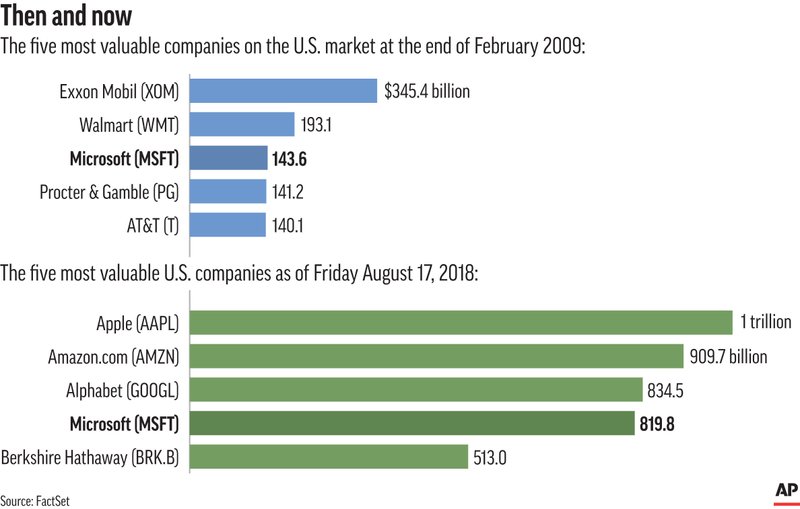
Apple’s iPhone debuted in 2007 and was a fairly new product when the
market hit its low point in early 2009. Today, it’s the source of most
of Apple’s revenue. Thanks in part to steady sales and the high
profitability of the phone, Apple became the first public company valued
at $1 trillion earlier this month.
Exxon, P&G, Walmart and AT&T remain among the most valuable companies on the market, but only one company that held a position in the top five in 2009 is still there today: Microsoft, which made huge gains in recent years by branching out into cloud computing.

Amazon, currently the second most valuable U.S. company at $925 billion, may have shaken up more industries than any other. Its focus on fast shipping and delivery to customers has forced companies that sell clothes, groceries, electronics and other goods to follow suit — or risk falling out of favor with investors. Amazon was worth less than $30 billion back in March 2009.
Alphabet has made steady gains during the bull market as Google came to dominate the online search market and the advertising revenue that comes with it. Alphabet also runs several smaller tech businesses including Waymo, a self-driving car company.
Warren Buffett’s conglomerate Berkshire Hathaway is a bit of an anomaly at the top of today’s market.
Berkshire does own a big chunk of Apple stock but isn’t particularly
focused on technology. It owns several insurance companies and has
investments in railroads, airlines, banks and Coca-Cola. The firm’s
value has more than tripled during the bull market as investors rewarded
it for deals including its purchase of Precision Castparts and Heinz
Foods, which then combined with Kraft.
The ranking seems very traditional, even a bit old-fashioned, compared to today, when big technology companies dominate the top of the market.
The top five most valuable companies at the end of February 2009 — Exxon Mobil, Walmart, Microsoft, Procter & Gamble and AT&T — includes several in sectors that are generally considered safe, a reflection of investors’ anxieties at a time the market was suffering huge losses.
Today, the top four most valuable companies on the U.S. market are concentrated in technology. They’ve used innovations in commerce, communications and software to change how people spend their time and money, and how they work.
Exxon, P&G, Walmart and AT&T remain among the most valuable companies on the market, but only one company that held a position in the top five in 2009 is still there today: Microsoft, which made huge gains in recent years by branching out into cloud computing.
Amazon, currently the second most valuable U.S. company at $925 billion, may have shaken up more industries than any other. Its focus on fast shipping and delivery to customers has forced companies that sell clothes, groceries, electronics and other goods to follow suit — or risk falling out of favor with investors. Amazon was worth less than $30 billion back in March 2009.
Alphabet has made steady gains during the bull market as Google came to dominate the online search market and the advertising revenue that comes with it. Alphabet also runs several smaller tech businesses including Waymo, a self-driving car company.
Warren Buffett’s conglomerate Berkshire Hathaway is a bit of an anomaly at the top of today’s market.
Tuesday, August 07, 2018
Fidelity zero cost funds
Fidelity shook the investment landscape
last week when it announced that it would offer two index funds with
zero expense ratios: Fidelity Zero Total Market Index (FZROX) and Fidelity Zero International Index (FZILX).
And not months in the future, but right away--they went live on Friday!
Also striking is that Fidelity removed investment minimums.
I have a couple of thoughts on why Fidelity would do this and what it means for investors. I'll start with the industry view first.
Loss Leaders
I have a couple of thoughts on why Fidelity would do this and what it means for investors. I'll start with the industry view first.
Loss Leaders
Schwab and Fidelity can afford to offer index funds below their cost because they will make it up with all the other funds and brokerage services that clients will buy. Fidelity has a unique position in the industry in that it is a big player in brokerage, 401(k)s, and both actively and passively managed funds. In addition, Fidelity has always wanted to be the biggest and best. Other parts of the business remain quite profitable. In fact, Schwab and Fidelity have been pushing costs higher in their No Transaction Fee networks by charging fund companies--not investors--ever more to be on their platforms. Thus, I would guess Schwab will follow suit with its own fee cut.
Monday, August 06, 2018
How to start investing
Weeks ago, we posted an infographic that provided an easy introduction to investing, and why it should be a priority.
But how does one actually get into the market?
Today’s infographic is a practical guide that explains and compares four different ways to get started:
Picking Stocks
Picking Managers
Picking Index Funds
Hire a professional planner
But how does one actually get into the market?
Today’s infographic is a practical guide that explains and compares four different ways to get started:
Picking Stocks
Picking Managers
Picking Index Funds
Hire a professional planner
Saturday, August 04, 2018
One Trillion Dollars
The maker of the iPhone and other gadgets became the world's first
publicly traded company with a market value of $1 trillion on Thursday.
The company reached the milestone a couple of hours into the trading session when its shares reached $207.04. They closed with a gain of 2.9 percent to $207.39. The shares are up 23 percent so far this year.
The achievement seemed unimaginable in September 1997 when Apple teetered on the edge of bankruptcy and founder Steve Jobs rejoined the company. If someone had dared to buy $10,000 worth of Apple stock at that point of desperation, the investment would now be worth about $2.6 million.
Amazon is the second-most valuable company with a market value of $895 billion. Alphabet, the parent company of Google, is third at $863 billion.
***
Apple milestones
April 1976 Apple is founded by Steve Jobs, Steve Wozniak and Ronald Wayne.
June 1977 The Apple II computer is released.
December 1980 Apple goes public and its stock beings trading on the Nasdaq.
April 1983 Former PepsiCo executive John Sculley becomes Apple’s CEO after being recruited by Steve Jobs.
January 1984 Jobs unveils the Macintosh, the first mass-market personal computer to feature a mouse and a graphical interface on the display screen.
September 1985 Jobs leaves Apple’s board after company’s directors side with CEO John Sculley in a dispute between the two men.
June 1993 Longtime Apple employee Michael Spindler becomes CEO, replacing Sculley, who remains the company’s chairman.
August 1993 Apple releases the Newton, a touch-screen device that was supposed to work like a digital notepad.
October 1993 Sculley steps down as Apple’s chairman after a disappointing earnings report.
February 1996 Apple hires turnaround specialist Gil Amelio as its CEO after Spindler’s efforts to sell the company to Sun Microsystems or IBM unravel.
December 1996 Apple buys Next Software, a company started by Jobs, for about $400 million. Jobs agrees to return to Apple as an adviser.
August 1997 Apple announces it’s getting a $150 million infusion from archrival Microsoft to help keep the company afloat.
September 1997 Apple announces Jobs will serve as its interim CEO.
May 1998 Jobs unveils a new line of personal computers called the iMac.
January 2000 Apple drops the “interim” preface from Jobs’ CEO title.
May 2001 Apple opens its first retail stores in Virginia and California.
October 2001 Jobs unveils a digital music player called the iPod.
April 2003 Jobs unveils iTunes, a digital music store that initially only could be accessed on Apple devices. A version that worked on personal computers powered by Windows software came out six months later to broaden the market.
August 2004 Jobs discloses he had surgery for a rare form of pancreatic cancer.
October 2005 Tim Cook is promoted to chief operating officer.
January 2007 Jobs unveils the iPhone.
March 2008 Jobs announces an app store for the iPhone.
January 2009 Jobs takes a six-month leave of absence to tend to his health, temporarily turning the reins over to Cook.
January 2010 Jobs unveils a tablet computer called the iPad.
January 2011 Jobs takes an indefinite leave of absence, leaving Cook in charge once again.
August 2011 Jobs resigns as CEO and Cook succeeds him.
October 2011 Jobs dies.
March 2012 Apple announces it is restoring a quarterly dividend for the first time since 1995.
September 2014 Apple announces the Apple Watch, its first new product since Jobs’ death.
March 2015 Apple becomes one of the 30 companies comprising the Dow Jones Industrial Average.
June 2015 Apple launches its music-streaming service.
June 2017 Apple announces its first internet-connected speaker, the HomePod.
September 2017 Apple unveils its first $1,000 phone, the iPhone X, in celebration of the product line’s 10th anniversary.
August 2018 Apple becomes the first publicly traded company valued at $1 trillion.
Sunday, July 22, 2018
Bezos no. 2 / make that no. 1
[7/22/18] Just as Prime Day is kicking off, Amazon CEO Jeff Bezos on Monday reportedly became the richest man in modern history.
[1/9/18] Bezos made $6.1 billion in five trading days in 2018. Now worth more than Bill Gates was ever worth.
[7/27/17] Bezos passes Gates this morning to become the richest man in the world. Asking for ideas on philanthropy.
[7/24/17] For the 30 years FORBES has been tracking global wealth, only five people have ranked on our annual compendium of wealth as the richest person on the planet. At least one other person held the title, but so briefly (just two days), that he never appeared at that rank on FORBES’ annual list of World’s Billionaires.
Now, Amazon CEO Jeff Bezos is poised to join this exclusive single digit club, as Amazon stock continues to soar. The online retailer’s shares climbed 1.3% on Monday, adding $1.1 billion to Bezos’ net worth. Bezos is now a mere $2 billion from assuming the No. 1 spot on FORBES Real-Time Billionaires List, which would put him in the company of an exclusive group of billionaires who have held the title. Bezos has a net worth FORBES estimates at $88.2 billion as of the close of markets on Monday, while Microsoft founder Bill Gates holds the top spot on the list with a $90.1 billion fortune.
[3/30/17] Jeff Bezos has leapt past Amancio Ortega and Warren Buffett to become the world’s second-richest person.
Bezos, 53, added $1.5 billion to his fortune as Amazon.com Inc. rose $18.32 on Wednesday, the day after the e-commerce giant said it plans to buy Dubai-based online retailer Souq.com. Bezos has a net worth of $75.6 billion on the Bloomberg Billionaires Index, $700 million more than Berkshire Hathaway Inc.’s Buffett and $1.3 billion above Ortega, the founder of Inditex S.A. and Europe’s richest person.
Amazon’s founder has added $10.2 billion this year to his wealth and $7 billion since the global equities rally began following the election of Donald Trump as U.S. president on Nov. 8. The rise is the third biggest on the Bloomberg index in 2017, after Chinese parcel-delivery billionaire Wang Wei’s $18.4 billion gain and an $11.4 billion rise for Facebook Inc. founder Mark Zuckerberg.
Buffett, who’s added $1.7 billion in 2017, has shed $4.7 billion since his fortune peaked at $79.6 billion on March 1. Ortega is up $2.1 billion year-to-date. Bezos remains $10.4 billion behind Microsoft co-founder Bill Gates, the world’s richest person with $86 billion.
*** 5/15/17 ***
Jeff Bezos, founder and CEO of Amazon, is one of the most powerful figures in tech, with a net worth of roughly $82 billion.
Today, his "Everything Store" sells more than $136 billion worth of goods a year.
Here's how the former hedge funder got his start and became one of the world's richest people.
According to the Bloomberg Billionaires Index,
which tracks the net worth of the 500 richest people in the world ,
Bezos is now worth $150 billion. The staggering number is more than Bill
Gates was ever worth, even during the height of the dot-com boom,
Bloomberg reported.
After adjusting for inflation, Microsoft cofounder Bill Gates was worth $149 billion in 1999.
Bezos
and Gates have been duking it out to be the world's richest person for
the last few years, but it's worth noting that Gates has donated a
sizable part of his fortune to charity — primarily to the Bill and
Melinda Gates Foundation. Right now, Gates has a net worth of $95.5
billion, almost $50 billion less than Bezos.
[1/9/18] Bezos made $6.1 billion in five trading days in 2018. Now worth more than Bill Gates was ever worth.
[7/27/17] Bezos passes Gates this morning to become the richest man in the world. Asking for ideas on philanthropy.
[7/24/17] For the 30 years FORBES has been tracking global wealth, only five people have ranked on our annual compendium of wealth as the richest person on the planet. At least one other person held the title, but so briefly (just two days), that he never appeared at that rank on FORBES’ annual list of World’s Billionaires.
Now, Amazon CEO Jeff Bezos is poised to join this exclusive single digit club, as Amazon stock continues to soar. The online retailer’s shares climbed 1.3% on Monday, adding $1.1 billion to Bezos’ net worth. Bezos is now a mere $2 billion from assuming the No. 1 spot on FORBES Real-Time Billionaires List, which would put him in the company of an exclusive group of billionaires who have held the title. Bezos has a net worth FORBES estimates at $88.2 billion as of the close of markets on Monday, while Microsoft founder Bill Gates holds the top spot on the list with a $90.1 billion fortune.
[3/30/17] Jeff Bezos has leapt past Amancio Ortega and Warren Buffett to become the world’s second-richest person.
Bezos, 53, added $1.5 billion to his fortune as Amazon.com Inc. rose $18.32 on Wednesday, the day after the e-commerce giant said it plans to buy Dubai-based online retailer Souq.com. Bezos has a net worth of $75.6 billion on the Bloomberg Billionaires Index, $700 million more than Berkshire Hathaway Inc.’s Buffett and $1.3 billion above Ortega, the founder of Inditex S.A. and Europe’s richest person.
Amazon’s founder has added $10.2 billion this year to his wealth and $7 billion since the global equities rally began following the election of Donald Trump as U.S. president on Nov. 8. The rise is the third biggest on the Bloomberg index in 2017, after Chinese parcel-delivery billionaire Wang Wei’s $18.4 billion gain and an $11.4 billion rise for Facebook Inc. founder Mark Zuckerberg.
*** 5/15/17 ***
Jeff Bezos, founder and CEO of Amazon, is one of the most powerful figures in tech, with a net worth of roughly $82 billion.
Today, his "Everything Store" sells more than $136 billion worth of goods a year.
Here's how the former hedge funder got his start and became one of the world's richest people.
Wednesday, July 18, 2018
Peter Lynch
[7/18/18] Robert Abbott reviews One Up on Wall Street:
Introduction - The Power of Common Knowledge
chapter 1 - Great Investors are not born
chapter 2 - The Wall Street Oxymorons (professional investing)
chapter 3 - Speculating or Investing?
chapter 4 - The Mirror Test
chapter 5 - Is this a good market? (don't ask)
chapter 6 - Stalking the Ten-Bagger
chapter 7 - 6 Categories of Stocks
chapter 8 - Finding Companies
chapter 9 - Places to avoid
chapter 10 - It's all about earnings
chapter 11 - the two minute monologue
chapter 12 - getting the facts
chapter 13 - Ratios and Data
chapter 14 - Three phases of a company's life
[7/18/18] You have plenty of time
[6/18/15] 20 Golden Rules
[12/24/14] Stocks to avoid.
[12/24/14] The Perfect Stock
[5/19/14] Picking Stocks Like Peter Lynch (1:10:06 video from gurufocus)
[4/2/14] The Peter Lynch Portfolio 29 (only $79/year from gurufocus)
[6/7/09] Peter Lynch videos (John Templeton and Louis Rukeyser too)
[8/27/07] On market timing: ""I don't remember anybody predicting the market right more than once, and they predict a lot," Lynch said in a PBS interview several years ago. He also likened investing in stocks with a one- or two-year horizon to "betting on red or black at the casino," adding, "What the market's going to do in one or two years, you don't know. Time is on your side in the stock market."
Asked in that same PBS interview whether average investors should follow a "buy-and-hold" strategy, Lynch responded, "They should buy, hold and when the market goes down, add to it. Every time the market goes down 10%, you add to it, [and] you would have better returns than the average of 11%, if you believe in it, if it's money you're not worried about [in the short term]."<! forbes article via russ ->
[8/22/06] Since I am looking at this review of Beating the Street, I figured I'd collect some of the other links to Lynch sprinkled among this blog.
The Wit and Wisdom of Peter Lynch
The different kinds of companies
The Peter Lynch approach to 'Understandable' Stocks
Peters's 21 Principals
Fast grower or low p/e?
Don't invest like Peter Lynch
[9/6/06] Review of One Up on Wall Street
[9/26/06 from mia notes from 3/31/01] Perhaps the most important thing I've learned from Peter Lynch is (to paraphrase) if the earnings keeps growing, the price will eventually follow. ... I'm trying to look up the exact quote and the closest I could come is this paragraph from One Up On Wall Street, Chapter Ten entitled Earnings, Earnings, Earnings:
Here's some more from the Legg Mason Semi-Annual report (6/30/05). Stocks rise with earnings. "Stock prices are highly positive correlated (over 0.90) with the direction of profits, not their rate of group."]
[2/11/13] Here's another similar quote from One Up On Wall Street
"You can see the importance of earnings on any chart that has an earnings line running alongside the stock price. On chart after chart the two lines will move in tandem, or if the stock price strays away from the earnings line, sooner or later it will come back to the earnings." Peter Lynch - 'One Up On Wall Street”
On the other hand, Keith Wibel observes that "Over 10-year periods, the major determinant of stock-price returns isn't growth in corporate profits, but rather changes in price-earnings multiples. The bull market of the 1980s represented a period when multiples in the stock market doubled- then they doubled again in the 1990s. Though earnings of the underlying businesses climbed about 6% per year, stock prices appreciated nearly 14% annually."
Introduction - The Power of Common Knowledge
chapter 1 - Great Investors are not born
chapter 2 - The Wall Street Oxymorons (professional investing)
chapter 3 - Speculating or Investing?
chapter 4 - The Mirror Test
chapter 5 - Is this a good market? (don't ask)
chapter 6 - Stalking the Ten-Bagger
chapter 7 - 6 Categories of Stocks
chapter 8 - Finding Companies
chapter 9 - Places to avoid
chapter 10 - It's all about earnings
chapter 11 - the two minute monologue
chapter 12 - getting the facts
chapter 13 - Ratios and Data
chapter 14 - Three phases of a company's life
[7/18/18] You have plenty of time
[6/18/15] 20 Golden Rules
[12/24/14] Stocks to avoid.
[12/24/14] The Perfect Stock
[5/19/14] Picking Stocks Like Peter Lynch (1:10:06 video from gurufocus)
[4/2/14] The Peter Lynch Portfolio 29 (only $79/year from gurufocus)
[6/7/09] Peter Lynch videos (John Templeton and Louis Rukeyser too)
[8/27/07] On market timing: ""I don't remember anybody predicting the market right more than once, and they predict a lot," Lynch said in a PBS interview several years ago. He also likened investing in stocks with a one- or two-year horizon to "betting on red or black at the casino," adding, "What the market's going to do in one or two years, you don't know. Time is on your side in the stock market."
Asked in that same PBS interview whether average investors should follow a "buy-and-hold" strategy, Lynch responded, "They should buy, hold and when the market goes down, add to it. Every time the market goes down 10%, you add to it, [and] you would have better returns than the average of 11%, if you believe in it, if it's money you're not worried about [in the short term]."<! forbes article via russ ->
[8/22/06] Since I am looking at this review of Beating the Street, I figured I'd collect some of the other links to Lynch sprinkled among this blog.
The Wit and Wisdom of Peter Lynch
The different kinds of companies
The Peter Lynch approach to 'Understandable' Stocks
Peters's 21 Principals
Fast grower or low p/e?
Don't invest like Peter Lynch
[9/6/06] Review of One Up on Wall Street
[9/26/06 from mia notes from 3/31/01] Perhaps the most important thing I've learned from Peter Lynch is (to paraphrase) if the earnings keeps growing, the price will eventually follow. ... I'm trying to look up the exact quote and the closest I could come is this paragraph from One Up On Wall Street, Chapter Ten entitled Earnings, Earnings, Earnings:
... it always comes to down to earnings and assets. Especially earnings. Sometimes it takes years for the stock price to catch up to a company's value, and the down periods last so long that investors begin to doubt that will ever happen. But value always win out ...I'm now looking at the April 1999 Worth and Lynch is featured in an ad for Fidelity Aggressive Growth. Here's his quote,
Despite 9 recessions since WWII, the stock market's up 63-fold because earnings are up 54-fold. Earnings drive the market.[My question isn't why the correlation, but why the disparity? At first it seems way off because I thought 55-fold would be double of 54-fold. But actually 108-fold is. 63-fold is only 17% higher than 54-fold.]
Here's some more from the Legg Mason Semi-Annual report (6/30/05). Stocks rise with earnings. "Stock prices are highly positive correlated (over 0.90) with the direction of profits, not their rate of group."]
[2/11/13] Here's another similar quote from One Up On Wall Street
"You can see the importance of earnings on any chart that has an earnings line running alongside the stock price. On chart after chart the two lines will move in tandem, or if the stock price strays away from the earnings line, sooner or later it will come back to the earnings." Peter Lynch - 'One Up On Wall Street”
On the other hand, Keith Wibel observes that "Over 10-year periods, the major determinant of stock-price returns isn't growth in corporate profits, but rather changes in price-earnings multiples. The bull market of the 1980s represented a period when multiples in the stock market doubled- then they doubled again in the 1990s. Though earnings of the underlying businesses climbed about 6% per year, stock prices appreciated nearly 14% annually."