Morgan Housel relates some interesting numbers. Here are some of them.
1. The unemployment rate for men is 8.4%. For married men, it's 4.9%.
2. The unemployment rate for college graduates is 3.9%. For high school dropouts, it's 13%.
3. According to The Wall Street Journal, in 2010, "for every 1% decrease in shareholder return, the average CEO was paid 0.02% more."
7. China's labor force grew by 145 million from 1990 to 2008. The entire U.S. labor force today is 156 million.
8. In 1998, oil industry executives told Congress
that oil would average $10 a barrel for the following decade. In
reality, it averaged $44.9 a barrel.
9. In 1999, one of the best years for the market ever, more than half of stocks in the S&P 500 declined. Two companies, Microsoft (Nasdaq: MSFT ) and Cisco, accounted for one-fifth of the index's return.
12. China's working-age population is expected to
shrink by more than 200 million between now and 2050. The U.S.' is
expected to rise by 47 million.
16. In Russia, 0.00007% of the population (100 people) controls 20% of the wealth. [talk about the 1%..]
19. For the 2012-2013 fiscal year, California will spend $8.7 billion on prisons and $4.8 billion on its UC and state college systems.
24. The U.S. makes up less than 5% of the world's
population, but a third of the world's spending on pharmaceuticals,
according to the IMS Institute for Healthcare.
25. Average monthly rent in New York City ($2,935) is about the same as the nationwide average monthly income ($3,052).
27. In 1929 -- the golden year before the Great
Depression-- 60% of American households earned a wage below what
Brookings Institution economists classified as "sufficient to supply
only basic necessities." Well over half the country lived in poverty, in
other words. One-fifth of households earned half the poverty wage.
30. Since 1994, stock market returns are flat if the three days before the Federal Reserve announces interest-rate policy are removed.
33. If you earn minimum wage, you'll need to work 923
hours to pay for a year at an average public four-year college. In 1980,
it took 254 hours.
43. Ten percent of Medicare recipients who received
hospital care made up 64% of the program's hospital spending in 2009,
according to The Wall Street Journal.
45. As a percentage of GDP, government spending was higher in 1983 under President Ronald Reagan than it will be this fiscal year (23.5% vs. 23.3%, respectively), according to data by the Tax Policy Center.
46. More government jobs were eliminated on net
in 2010 than in any other year since at least 1939. As a percentage of
government workers, the decline was the largest since 1947.
47. According to Sheldon Jacobson of the University of
Illinois, the added weight carried by vehicles due to obesity in America
consumes an additional 938 million gallons of gasoline a year.
48. The median American family's net worth
fell to $77,300 in 2010 from $126,400 in 2007, according to the Federal
Reserve's Survey of Consumer Finance. That erased nearly two decades of
accumulated wealth.
49. According to UCLA: "Only 3.1 percent of the world's
children live in the United States, but U.S. families buy more than 40
percent of the toys consumed globally."
51. A study of retired investors between 1999 and
2009 showed those who hired a stockbroker underperformed those managing
their own money by 1.5% a year. "Fees accounted for only about half the
gap," writes Jason Zweig of The Wall Street Journal.
60. Since 1968, the U.S. population has increased from 200 million to 314 million, and federal government employees have declined from 2.9 million to 2.8 million.
61. According to the Boston Consulting Group,
manufacturing wages, benefits and taxes are $22.30 an hour in America,
compared with $2 an hour in China. But since American factory workers
are more productive, China's effective labor costs are only 55% lower
than Americans, and may drop to less than a third later this decade.
65. As of June 2011, 32% of American homes were
cellphone only, up from 17.5% in 2008, according to the National Center
for Health Statistics.
66. Solar panel prices have plunged 82% since 2009, according to Bloomberg.
71. In 1989, the CEOs of the seven largest U.S. banks
earned an average of 100 times what a typical household made. By 2007,
more than 500 times.
72. In 1990, the three largest U.S. banks held 10% of the industry's assets. By 2008, the top three controlled 40% of the assets.
73. Clean water and sewers were voted "the greatest medical advance" since 1840 by readers of the British Journal of Medicine.
75. America is home to less than 5% of the world's population, but nearly a quarter of its prisoners.
79. In May this year, the Dow fell 18 days and rose
four days -- the worst combination since 1903. It never posted two
consecutive gains, likely for the first time ever.
81. According to John Cawley of Cornell and Chad
Meyerhoefer of Lehigh University, obese people incur annual medical
costs $2,741 higher than non-obese people, or almost $200 billion
nationwide.
82. According to economist Christina Romer, real GDP
per capita in American grew 0.58% a year from 1800-1840; 1.44% from
1840-1880; 1.78% from 1880-1920; 1.68% from 1920-1960, and 1.82% from
1960-1991. We not only grew richer, but at an increasing rate.
83. In 2007, the Congressional Budget Office estimated
federal tax receipts would be $3.4 trillion in 2012. In reality, they'll
be around $2.5 trillion.
86. According to economists Thomas Piketty and Emmanuel
Saez, 80% of all income growth from 1980 to 2005 went to the top 1% of
wage earners.
88. If you're fed up with unemployment caused by
offshoring, you'll love this: According to a 2006 Government
Accountability Organization study, the processing of unemployment
insurance claims are partially offshored in several states.
90. We tend to underestimate how powerful the agriculture boom has been in the last century. The 1952 book The Big Change
describes life in America in the year 1900: "In most parts of the
United States people were virtually without fresh fruit and green
vegetables from late autumn to late spring."
92. According to biographer Ron Chernow, John D.
Rockefeller's net worth peaked at $900 million in 1913. That equaled
2.3% of the U.S. economy. A comparable net worth today would be $340
billion, or eight times richer than Warren Buffett.
94. According to Morgan Stanley, 9% of all S&P trading volume is in Apple stock. One in 25 of all hedge funds has more than 10% of their fund in Apple.
96. America is aging. Older workers (age 55+) are about to overtake younger workers (age 25-34) for the first time.
97. According to the Pew Research Center, every one of
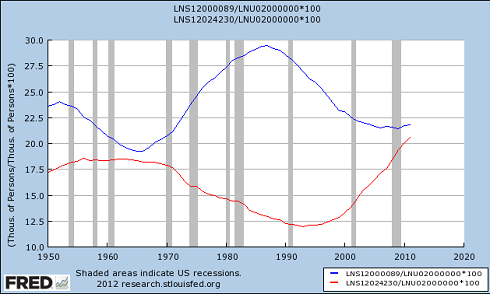
the eight largest EU nations ranks Germany as the hardest working --
except for Greece, which ranks itself as the hardest working. Five of
the eight rank Greece as the least hardworking.
98. In 1900, the standard American workweek was 10
hours a day, six days week. Historian Frederick Lewis Allen notes in a
1952 essay: "If anybody had suggested a five-day week he would have been
considered demented."
99. Facebook (Nasdaq: FB )
claims 100 billion friend connections have been made on its social
network. That's about the same number of humans that have ever lived
since 50,000 B.C., according to the Population Reference Bureau.
For more on the recession's impact on the economy, check out my latest e-book, 50 Years in the Making: The Great Recession and Its Aftermath for your iPad, Kindle, on Amazon or Barnes & Noble. It's short, packed with information, and costs less than a buck.
***
[8/3/12] The economy has added 4 million jobs since February 2010, when the jobs
market bottomed. But that's just 46% of the 8.78 million jobs lost
between February 2008 and the 2010 low. About 4.5 million private-sector
jobs were added in that period, which means public-sector employment
fell by a half million. Most of that is in the state and local
government sectors, primarily in education.
Saturday, July 21, 2012

Friday, July 13, 2012
too much credit?
We often hear that one of America's great strengths is the depth of
its financial markets. That's true to a point, but there are limits. A
new study by the International Monetary Fund shows that rich countries
hit a point "at which financial depth no longer contributes to increasing
the efficiency of investment."
That point, they showed (link opens PDF file) this week, tends to hit when a country's private sector debt totals 80%-100% of gross domestic product. The United States hit that threshold two decades ago, and now chugs along at about double the level:
That point, they showed (link opens PDF file) this week, tends to hit when a country's private sector debt totals 80%-100% of gross domestic product. The United States hit that threshold two decades ago, and now chugs along at about double the level:
does the Fed drive the stock market?
In one of the most startling studies I've ever seen, researchers from the Federal Reserve this week measured
how much the stock market is influenced by...the Federal Reserve. Their
conclusion: "Since 1994, [stock] returns are essentially flat if the
three-day windows around scheduled FOMC announcement days are excluded."
The Federal Reserve announces what it's going to do to interest rates eight times a year at Federal Open Market Committee meetings. These are scheduled in advanced and well-publicized, so investors know exactly when the goods are coming.
Since 1994 (when the Fed started publicizing its moves), the S&P 500 has risen from 450 to 1300. But remove the 24 hours just prior to FOMC announcements, and returns fall to almost nothing:
The Federal Reserve announces what it's going to do to interest rates eight times a year at Federal Open Market Committee meetings. These are scheduled in advanced and well-publicized, so investors know exactly when the goods are coming.
Since 1994 (when the Fed started publicizing its moves), the S&P 500 has risen from 450 to 1300. But remove the 24 hours just prior to FOMC announcements, and returns fall to almost nothing:
interview with Buffett, Simpson, Bowles
This is a transcript of Warren
Buffett, Alan Simpson, and Erskine Bowles' Sun Valley live interview on
CNBC's Squawk Box, July 12, 2012, from 8am to 9am ET.
They discussed why the U.S. needs to address its mounting debt problem and suggested some solutions.
[via cougar3]
[via cougar3]
Thursday, July 12, 2012
10 Myths About Social Security
The myths deal mainly about the notion that Social Security is going broke.
While that might not be technically true, reading the article, all the myths seem to have an element of truth. So to me, they're not really myths.
[10/16/12] 5 Huge Myths About Social Security
[3/6/13] 5 ways to fix Social Security
[7/11/14] A brief history of Social Security
While that might not be technically true, reading the article, all the myths seem to have an element of truth. So to me, they're not really myths.
[10/16/12] 5 Huge Myths About Social Security
[3/6/13] 5 ways to fix Social Security
[7/11/14] A brief history of Social Security
Wednesday, July 11, 2012
a look at the archives
Now let's talk S&P 500 earnings.
It's 2007, and the stock market is booming to an all-time high. Analysts foresee the S&P 500 earning $94.20 in 2008, a new record. "It's a really good investing environment in general right now," an analyst tells Bloomberg. In fact, it was one of the worst in history.
The S&P ended up earning half the amount analysts expected in 2008, and stocks plunged nearly 50%.
Another whoops.
By 2009 gloom was pervasive. Bloomberg lamented "the longest earnings slump since the Great Depression." Analysts expected the S&P 500 to earn $53 a share in 2010, and $63 in 2011.
In reality, the index earned $83 and $96, respectively. Here again, for the last five years you could have been a top performer by taking analysts' earnings estimates and multiplying or dividing them by two.
Can we just admit that no one knows what earnings will do in the future?
It's 2007, and the stock market is booming to an all-time high. Analysts foresee the S&P 500 earning $94.20 in 2008, a new record. "It's a really good investing environment in general right now," an analyst tells Bloomberg. In fact, it was one of the worst in history.
The S&P ended up earning half the amount analysts expected in 2008, and stocks plunged nearly 50%.
Another whoops.
By 2009 gloom was pervasive. Bloomberg lamented "the longest earnings slump since the Great Depression." Analysts expected the S&P 500 to earn $53 a share in 2010, and $63 in 2011.
In reality, the index earned $83 and $96, respectively. Here again, for the last five years you could have been a top performer by taking analysts' earnings estimates and multiplying or dividing them by two.
Can we just admit that no one knows what earnings will do in the future?
Tuesday, July 03, 2012
(Charlie Munger on) ideology
In a May 2007 speech at USC, Charlie Munger said the following about ideology:
“Another thing I think should be avoided is extremely intense ideology because it cabbages up one’s mind; you’ve seen that, and you see it a lot with T.V. preachers, for instance – they’ve all got different ideas about theology and a lot of them have minds that are made of cabbage. But that can also happen with political ideology, and when you’re young it’s easy to drift into loyalties and when you announce that you’re a loyal member and you start shouting the orthodox ideology out, what you’re doing is pounding it in, pounding it in, and you’re gradually ruining your mind. So you want to be very, very careful of this ideology. It’s a big danger… I have what I call an iron prescription that helps me keep sane when I naturally drift toward preferring one ideology over another and that is: I’m not entitled to have an opinion on this subject unless I can state the arguments against my position better than the people who support it. I think only when I’ve reached that state I am qualified to speak. This business of not drifting into extreme ideology is a very, very important thing in life.”
[And since I follow everything Munger says, I am forced to agree..]
“Another thing I think should be avoided is extremely intense ideology because it cabbages up one’s mind; you’ve seen that, and you see it a lot with T.V. preachers, for instance – they’ve all got different ideas about theology and a lot of them have minds that are made of cabbage. But that can also happen with political ideology, and when you’re young it’s easy to drift into loyalties and when you announce that you’re a loyal member and you start shouting the orthodox ideology out, what you’re doing is pounding it in, pounding it in, and you’re gradually ruining your mind. So you want to be very, very careful of this ideology. It’s a big danger… I have what I call an iron prescription that helps me keep sane when I naturally drift toward preferring one ideology over another and that is: I’m not entitled to have an opinion on this subject unless I can state the arguments against my position better than the people who support it. I think only when I’ve reached that state I am qualified to speak. This business of not drifting into extreme ideology is a very, very important thing in life.”
[And since I follow everything Munger says, I am forced to agree..]
Saturday, June 30, 2012
The One Thing
Anand Chokkavelu writes of 100 things he's learned in investing.
Me, I [try to] look for the one main thing. Let me see if it's in the list.
Hmm. Not really. [Well maybe #29 sort of touches on it]
Let's see if I can find an appropriate Warren Buffett quote.
Well I guess there's this one:
If a business does well, the stock eventually follows.
Me, I [try to] look for the one main thing. Let me see if it's in the list.
Hmm. Not really. [Well maybe #29 sort of touches on it]
Let's see if I can find an appropriate Warren Buffett quote.
Well I guess there's this one:
If a business does well, the stock eventually follows.
Saturday, June 23, 2012
How to play the Obamacare ruling
The Supreme Court's highly anticipated ruling on the
constitutionality of "Obamacare" will rattle the stock and bond markets
every bit as much as it shakes up the 2012 presidential contest.
With Americans spending nearly $2.7 trillion a year on medical treatments, health care accounts for 18% of gross domestic product and 12% of the Standard & Poor's 500. In other words, chances are good that your investment portfolio will be affected by the high court's decision.
It looks like the ruling will be handed down the week of June 24, the end of the court's current session. A decision either way could give a broad lift to the health-care sector in the short term, because it would eliminate uncertainty. But soon after, the stocks of various types of companies within health care would most likely follow separate courses. Regardless of whether the law is upheld or struck down or modified, some stocks will get clobbered, some will pop and others will barely budge.
With Americans spending nearly $2.7 trillion a year on medical treatments, health care accounts for 18% of gross domestic product and 12% of the Standard & Poor's 500. In other words, chances are good that your investment portfolio will be affected by the high court's decision.
It looks like the ruling will be handed down the week of June 24, the end of the court's current session. A decision either way could give a broad lift to the health-care sector in the short term, because it would eliminate uncertainty. But soon after, the stocks of various types of companies within health care would most likely follow separate courses. Regardless of whether the law is upheld or struck down or modified, some stocks will get clobbered, some will pop and others will barely budge.
Thursday, June 21, 2012
Larry Ellison is buying Lanai
Hawaii’s sixth-largest island,
Lanai, has been known by different nicknames through the decades — from
the “Pineapple Island” to the “Private Island” and at present “Hawaii’s
Most Enticing Island.” One could soon call it “Ellison Island.”
The third-richest man in
America, Oracle Corp. co-founder and CEO Larry Ellison, is buying Lanai
from fellow billionaire David Murdock for hundreds of millions of
dollars in cash, though the exact price was not disclosed.
Friday, June 15, 2012
my investing bookshelf
I figure since I created my list of dog books, I might as well post the list of investing books that I have on my bookshelf (or somewhere).
Richard Band, Contrary Investing for the 1990s (1989)
Peter Brimelow, The Wall Street Gurus (1986)
Mary Buffett and David Clark, Buffettology (1997)
Charles B. Carlson, Eight $teps To $even Figure$ (2000)
George S. Clason, The Richest Man in Babylon (1989)
James J. Cramer, Mad Money: Watch TV, Get Rich (2006)
James J. Cramer, Stay Mad for Life (2007)
Lawrence Cunningham, The Essays of Warren Buffett (1998)
Pat Dorsey, The Five Rules for Successful Stock Investing (2004)
Charles D. Ellis, The Investor's Anthology (1997)
Mark Fisher, The Instant Millionaire (1993)
Mark Fisher, Millionaire's Secrets (1996)
Norman Fosback, Stock Market Logic (1976)
David and Tom Gardner, The Motley Fool Investment Guide (1996
J. Paul Getty, How To Be Rich (1986)
Robert Hagstrom, The Warren Buffett Way (1994)
Robert Hagstrom, The Warren Buffett Portfolio (1999)
Napoleon Hill, Think and Grow Rich (1983)
Andrew Kilpatrick, Of Permanent Value: The Story of Warren Buffett (1994)
Peter Krass, The Book of Investing Wisdom (1999)
Robert Lichello, How To Make $1,000,000 in the Stock Market (1985)
Janet Lowe, Warren Buffett Speaks (1997)
Roger Lowenstein, Buffett: The Making of an American Capitalist (1995)
Peter Lynch, One Up On Wall Street (1990)
Peter Lynch, Beating The Street (1994)
Peter Lynch, Learn To Earn (1997)
Michael Mauboussin, More Than You Know (2006)
William J. O'Neil, How To Make Money In Stocks (1994)
James P. O'Shaughnessy, What Works On Wall Street (1996)
James Pardoe, How Buffett Does It (2005)
William Poundstone, Fortune's Formula (2006)
Martin Pring, Investment Psychology Explained (1992)
Siimon Reynolds, Thoughts of Chairman Buffett (1998)
John Rothchild, A Fool and his Money (1988)
Howard Ruff, Making Money (1986)
Adam Smith, The Money Game (1967)
Adam Smith, Supermoney (1972)
Thomas J. Stanley and William D. Danko, The Millionaire Next Door (1996)
Madelon DeVoe Talley, The Passionate Investors (1987)
Andrew Tobias, Still! The Only Investment Guide You'll Ever Need (1978)
Andrew Tobias, Getting By on $100,000 a Year (1981)
Andrew Tobias, Money Angles (1985)
Phil Town, Rule #1 (2007)
John Train, The Money Masters (1980)
John Train: The Midas Touch (1988)
John Train, The New Money Masters (1990)
John Train, The Craft of Investing (1994)
Clint Willis, What Do I Do With My Money Now? (2003)
Martin Zweig, Winning On Wall Street (1986)
And on my wanted/reminder list:
Mary Buffett and David Clark, The Tao of Warren Buffett
Joel Greenblatt, The Little Book The Beats The Market
Janet Lowe, Damn Right: Behind the Scenes with Berkshire Hathaway Billionaire Charlie Munger
Charlie Munger, Poor Charlie's Almanack
Peter Sander and Janet Haley, Value Investing for Dummies
*** [8/29/14 via facebook]
A review of 26 books (out of 52)
Richard Band, Contrary Investing for the 1990s (1989)
Peter Brimelow, The Wall Street Gurus (1986)
Mary Buffett and David Clark, Buffettology (1997)
Charles B. Carlson, Eight $teps To $even Figure$ (2000)
George S. Clason, The Richest Man in Babylon (1989)
James J. Cramer, Mad Money: Watch TV, Get Rich (2006)
James J. Cramer, Stay Mad for Life (2007)
Lawrence Cunningham, The Essays of Warren Buffett (1998)
Pat Dorsey, The Five Rules for Successful Stock Investing (2004)
Charles D. Ellis, The Investor's Anthology (1997)
Mark Fisher, The Instant Millionaire (1993)
Mark Fisher, Millionaire's Secrets (1996)
Norman Fosback, Stock Market Logic (1976)
David and Tom Gardner, The Motley Fool Investment Guide (1996
J. Paul Getty, How To Be Rich (1986)
Robert Hagstrom, The Warren Buffett Way (1994)
Robert Hagstrom, The Warren Buffett Portfolio (1999)
Napoleon Hill, Think and Grow Rich (1983)
Andrew Kilpatrick, Of Permanent Value: The Story of Warren Buffett (1994)
Peter Krass, The Book of Investing Wisdom (1999)
Robert Lichello, How To Make $1,000,000 in the Stock Market (1985)
Janet Lowe, Warren Buffett Speaks (1997)
Roger Lowenstein, Buffett: The Making of an American Capitalist (1995)
Peter Lynch, One Up On Wall Street (1990)
Peter Lynch, Beating The Street (1994)
Peter Lynch, Learn To Earn (1997)
Michael Mauboussin, More Than You Know (2006)
William J. O'Neil, How To Make Money In Stocks (1994)
James P. O'Shaughnessy, What Works On Wall Street (1996)
James Pardoe, How Buffett Does It (2005)
William Poundstone, Fortune's Formula (2006)
Martin Pring, Investment Psychology Explained (1992)
Siimon Reynolds, Thoughts of Chairman Buffett (1998)
John Rothchild, A Fool and his Money (1988)
Howard Ruff, Making Money (1986)
Adam Smith, The Money Game (1967)
Adam Smith, Supermoney (1972)
Thomas J. Stanley and William D. Danko, The Millionaire Next Door (1996)
Madelon DeVoe Talley, The Passionate Investors (1987)
Andrew Tobias, Still! The Only Investment Guide You'll Ever Need (1978)
Andrew Tobias, Getting By on $100,000 a Year (1981)
Andrew Tobias, Money Angles (1985)
Phil Town, Rule #1 (2007)
John Train, The Money Masters (1980)
John Train: The Midas Touch (1988)
John Train, The New Money Masters (1990)
John Train, The Craft of Investing (1994)
Clint Willis, What Do I Do With My Money Now? (2003)
Martin Zweig, Winning On Wall Street (1986)
And on my wanted/reminder list:
Mary Buffett and David Clark, The Tao of Warren Buffett
Joel Greenblatt, The Little Book The Beats The Market
Janet Lowe, Damn Right: Behind the Scenes with Berkshire Hathaway Billionaire Charlie Munger
Charlie Munger, Poor Charlie's Almanack
Peter Sander and Janet Haley, Value Investing for Dummies
*** [8/29/14 via facebook]
A review of 26 books (out of 52)
Thursday, June 07, 2012
successful dividend investors
Dividend investing is as sexy as watching paint dry on the wall.
Defining an entry criteria that selects quality dividend stocks with
rising dividends over time and then patiently reinvesting these
dividends while sitting on your hands is not exciting.
I did some research and uncovered several sucessful successful dividend investors, whose stories provide reassurance that the traits of successful dividend investing I outlined in a previous post are indeed accurate.
Anne Scheiber turned a $5,000 investment in 1944 into $22 million by the time of her death at the age of 101 in 1995. Anne Scheiber worked as an IRS auditor for 23 years, never earning more than $3150/year. The one important lesson she learned auditing tax returns was that the surest way to become rich in America is by accumulating stocks. [8/2/14] [8/16/19]
Grace Groner, who turned a small $180 investment in 1935 into $7 million by the time of her death in 2010. Ms Groner, who worked as a secretary at Abbott Laboratories for 43 years invested $180 in 3 shares of Abbott Laboratories (ABT) in 1935. She then simply reinvested the dividends for the next 75 years. She never sold, but just held on to her shares.
The third dividend investor is Warren Buffett, the Oracle of Omaha himself. In a previous article, I have outlined the reasoning behind my belief that Buffett is a closet dividend investor. He explicitly noted in his 2009 letter that "the best businesses by far for owners continue to be those that have high returns on capital and that require little incremental investment to grow".
I did some research and uncovered several sucessful successful dividend investors, whose stories provide reassurance that the traits of successful dividend investing I outlined in a previous post are indeed accurate.
Anne Scheiber turned a $5,000 investment in 1944 into $22 million by the time of her death at the age of 101 in 1995. Anne Scheiber worked as an IRS auditor for 23 years, never earning more than $3150/year. The one important lesson she learned auditing tax returns was that the surest way to become rich in America is by accumulating stocks. [8/2/14] [8/16/19]
Grace Groner, who turned a small $180 investment in 1935 into $7 million by the time of her death in 2010. Ms Groner, who worked as a secretary at Abbott Laboratories for 43 years invested $180 in 3 shares of Abbott Laboratories (ABT) in 1935. She then simply reinvested the dividends for the next 75 years. She never sold, but just held on to her shares.
The third dividend investor is Warren Buffett, the Oracle of Omaha himself. In a previous article, I have outlined the reasoning behind my belief that Buffett is a closet dividend investor. He explicitly noted in his 2009 letter that "the best businesses by far for owners continue to be those that have high returns on capital and that require little incremental investment to grow".
Wednesday, June 06, 2012
Ron Paul's portfolio
Last May, Ron Paul filed his financial disclosure form, and The Wall Street Journal enlisted financial analyst William Bernstein to scrutinize his investments.
“Paul’s portfolio isn’t merely different,” said an astonished Journal, “it’s shockingly different.”
Twenty-one percent of his $2.4 to $5.5 million was in real estate, 14 percent in cash. He owns no bonds. Only 0.1 percent is invested in stocks, and Paul bought these “short,” betting the price will plunge. Every other nickel is sunk into gold and silver mining companies.
Bernstein “had never seen such an extreme bet on economic catastrophe,” said the Journal.
“This portfolio,” said Bernstein, “is a half step away from a cellar-full of canned goods and 9-millimeter rounds.”
“You can say this for Ron Paul,” conceded the Journal. “In investing as in politics, (Paul) has the courage of his convictions.”
Indeed, he does. Paul’s investments mirror his belief that the empire of debt is coming down and Western governments will never repay — in dollars of the same value — what they have borrowed.
- seen in Midweek, 1/18/12
“Paul’s portfolio isn’t merely different,” said an astonished Journal, “it’s shockingly different.”
Twenty-one percent of his $2.4 to $5.5 million was in real estate, 14 percent in cash. He owns no bonds. Only 0.1 percent is invested in stocks, and Paul bought these “short,” betting the price will plunge. Every other nickel is sunk into gold and silver mining companies.
Bernstein “had never seen such an extreme bet on economic catastrophe,” said the Journal.
“This portfolio,” said Bernstein, “is a half step away from a cellar-full of canned goods and 9-millimeter rounds.”
“You can say this for Ron Paul,” conceded the Journal. “In investing as in politics, (Paul) has the courage of his convictions.”
Indeed, he does. Paul’s investments mirror his belief that the empire of debt is coming down and Western governments will never repay — in dollars of the same value — what they have borrowed.
- seen in Midweek, 1/18/12
Wednesday, May 30, 2012
presidents and the unemployment rate
Looking at the table,
unemployment went down under Reagan, zoomed up under Bush, went down under Clinton, went up under W, and is up under Obama.
However it has gone up only 0.3% under Obama. Where it went up 1.9% under Bush. And 1.1% and 2.5% under W.
Assuming you trust the numbers. And, of course, suspecting the zillions of other factors involved.
unemployment went down under Reagan, zoomed up under Bush, went down under Clinton, went up under W, and is up under Obama.
However it has gone up only 0.3% under Obama. Where it went up 1.9% under Bush. And 1.1% and 2.5% under W.
Assuming you trust the numbers. And, of course, suspecting the zillions of other factors involved.
Wednesday, May 16, 2012
charts that show inflation is near
the charts begin with the Federal Reserve's aggressive response to the
financial crisis and end with a dramatic increase in the price of
commodities such as corn, oil, and gold. The charts in between
illustrate why the dramatic growth in the money supply has only begun to exert its influence on consumer prices.
Of course, if it's true that higher inflation is on the way, and I believe that it is, then it's important to start thinking about how to inflation-proof your portfolio.
As I discussed previously, the traditional way to do so is to anchor it in tangible assets. You can do this directly through an exchange-traded fund like the SPDR Gold Trust (NYSE: GLD) , or indirectly by investing in companies that produce tangible assets like Molycorp (NYSE: MCP) , a rare earth producer, or Paramount Gold and Silver (NYSE: PZG) , an exploration-stage mining company in Mexico.
A second approach, and the one I prefer, is to invest in consumer goods companies that can pass price increases onto their customers. Coca-Cola (NYSE: KO) and Procter & Gamble (NYSE: PG) are textbook examples of this given the power of their respective brands.
Of course, if it's true that higher inflation is on the way, and I believe that it is, then it's important to start thinking about how to inflation-proof your portfolio.
As I discussed previously, the traditional way to do so is to anchor it in tangible assets. You can do this directly through an exchange-traded fund like the SPDR Gold Trust (NYSE: GLD) , or indirectly by investing in companies that produce tangible assets like Molycorp (NYSE: MCP) , a rare earth producer, or Paramount Gold and Silver (NYSE: PZG) , an exploration-stage mining company in Mexico.
A second approach, and the one I prefer, is to invest in consumer goods companies that can pass price increases onto their customers. Coca-Cola (NYSE: KO) and Procter & Gamble (NYSE: PG) are textbook examples of this given the power of their respective brands.
Saturday, April 14, 2012
inflation
Yes, there has been inflation over the last century -- so much that any time inflation is discussed someone feels obligated to point out that a dollar has been devalued by well over 90% in the last century. That's true. But inflation has pushed average wages up by a far greater amount, causing the share of income spent on most consumer goods to plunge. The average household spent 43% of their income on food in 1900, 30% in 1950, and 13% in 2003.
Such shifts are often missed when discussing inflation and wealth. At an investment conference two years ago, Berkshire Hathaway (NYSE: BRK-B ) Vice Chairman Charlie Munger remarked: "I remember the $0.05 hamburger and a $0.40-per-hour minimum wage, so I've seen a tremendous amount of inflation in my lifetime. Did it ruin the investment climate? I think not."
Later that day, a questioner asked Munger about inflation's "devastation" over the past half-century. In 1950, a corned-beef sandwich at a local diner cost $0.55, the questioner noted. Today it's $10. How can a country be anything but a failure when its currency loses 95% of its value to inflation, he wondered.
"If you think the past half-century was bad, you will have serious problems in life," Munger replied. "Despite inflation, we've been a huge success. Real GDP has grown 2% per year per capita. That's fantastic. The period you describe as miserable was a tremendous time for the American economy. You've described success."
Such shifts are often missed when discussing inflation and wealth. At an investment conference two years ago, Berkshire Hathaway (NYSE: BRK-B ) Vice Chairman Charlie Munger remarked: "I remember the $0.05 hamburger and a $0.40-per-hour minimum wage, so I've seen a tremendous amount of inflation in my lifetime. Did it ruin the investment climate? I think not."
Later that day, a questioner asked Munger about inflation's "devastation" over the past half-century. In 1950, a corned-beef sandwich at a local diner cost $0.55, the questioner noted. Today it's $10. How can a country be anything but a failure when its currency loses 95% of its value to inflation, he wondered.
"If you think the past half-century was bad, you will have serious problems in life," Munger replied. "Despite inflation, we've been a huge success. Real GDP has grown 2% per year per capita. That's fantastic. The period you describe as miserable was a tremendous time for the American economy. You've described success."
Friday, April 13, 2012
avoiding value traps: four questions
Investing is a curious balance between art and science; value investors, who by their nature are generally contrarian, almost always find themselves debating whether a security is a steal or a value trap. At the same time, if that company is well known, it is likely being ridiculed in the media and showered with contempt in the blogosphere. This is the point of maximum pessimism; and as the great investor John Templeton noted, this is the best time to buy.
what I want to address is how to avoid value traps. While this list is in no way complete, it covers a few of the key questions that I believe should be asked before attempting to catch a falling knife:
1) What are the odds that this company will not be around ten years from today? – As I noted in my previous article “Kill the Company,” this is the first question Buffett will always ask: Is there any chance that a significant amount of my capital could be subject to catastrophe risk? As Alice Schroeder noted, if the answer is yes, he just stops thinking; this is a good example to follow.
2) What is the company’s sustainable competitive advantage? – In my mind, this is essentially the same thing as No. 1: What does this company do that all but guarantees its existence 10, 20 and 50 years from now? For Coca-Cola (KO), it delivers a product with unmatched brand equity (partly due to significant economies of scale) via an unrivaled distribution network; in addition, it has levered this success to enter new categories (juices, teas, sports drinks, etc.) in order to all but guarantee its continued growth even if the shift away from CSDs experienced in the U.S. continues in the future.
3) Does the company have the financial strength to ride out a rough patch?).
... Nokia (NOK); while the company has gotten clobbered by Apple’s (AAPL) iPhone and Google’s (GOOG) Android operating system, they are fine from a financial perspective. Even after losing more than 1 billion euros last year, the company has net cash of 5 billion euros, leaving them plenty of time to right the ship (now that we abandoned that burning oil rig, right Mr. Elop?) before the balance sheet becomes an issue.
4) Would you LOVE to see the stock fall 50%? – For me, this is the ultimate test for an investment. If you can look at a company’s competitive position within an industry and know that you would love to buy more at half of today’s price regardless of the short-term noise, that’s a good sign in my book (I've been begging for many to do some since I missed out in 2009, but so far, no gravy). If this isn’t true, there are two likely culprits: Either you question the long-term sustainability of the business, or you don’t understand enough about the company to feel comfortable with bouts of volatility. Either way, its probably a sign that you should move on to the next opportunity.
what I want to address is how to avoid value traps. While this list is in no way complete, it covers a few of the key questions that I believe should be asked before attempting to catch a falling knife:
1) What are the odds that this company will not be around ten years from today? – As I noted in my previous article “Kill the Company,” this is the first question Buffett will always ask: Is there any chance that a significant amount of my capital could be subject to catastrophe risk? As Alice Schroeder noted, if the answer is yes, he just stops thinking; this is a good example to follow.
2) What is the company’s sustainable competitive advantage? – In my mind, this is essentially the same thing as No. 1: What does this company do that all but guarantees its existence 10, 20 and 50 years from now? For Coca-Cola (KO), it delivers a product with unmatched brand equity (partly due to significant economies of scale) via an unrivaled distribution network; in addition, it has levered this success to enter new categories (juices, teas, sports drinks, etc.) in order to all but guarantee its continued growth even if the shift away from CSDs experienced in the U.S. continues in the future.
3) Does the company have the financial strength to ride out a rough patch?).
... Nokia (NOK); while the company has gotten clobbered by Apple’s (AAPL) iPhone and Google’s (GOOG) Android operating system, they are fine from a financial perspective. Even after losing more than 1 billion euros last year, the company has net cash of 5 billion euros, leaving them plenty of time to right the ship (now that we abandoned that burning oil rig, right Mr. Elop?) before the balance sheet becomes an issue.
4) Would you LOVE to see the stock fall 50%? – For me, this is the ultimate test for an investment. If you can look at a company’s competitive position within an industry and know that you would love to buy more at half of today’s price regardless of the short-term noise, that’s a good sign in my book (I've been begging for many to do some since I missed out in 2009, but so far, no gravy). If this isn’t true, there are two likely culprits: Either you question the long-term sustainability of the business, or you don’t understand enough about the company to feel comfortable with bouts of volatility. Either way, its probably a sign that you should move on to the next opportunity.
Friday, March 23, 2012
Howard Marks: Déjà Vu All Over Again
[3/23/12 - VE1 passed along the latest memo from Howard Marks.]
... If I were asked to name just one way to figure out whether something’s a bargain or not, it would be through assessing how much optimism is incorporated in its price.
No matter how good the fundamental outlook is for something, when investors apply too much optimism in pricing it, it won‟t be a bargain. That was the story of the Internet bubble; the Internet was expected to change the world, and it did, but when the optimism surrounding it proved to have been excessive, stock prices were decimated.
Conversely, no matter how bad the outlook is for an asset, when little or no optimism is incorporated in its price, it can easily be a bargain capable of providing outsized returns with limited risk.
Even with a bad “story,” the price of an asset is unlikely to decline (other than perhaps in the very short term) unless the story deteriorates further or the optimism abates. And if there‟s no optimism built into its price, certainly the latter can‟t happen.
Marks is the chairman of Oaktree Capital. His memos dating back to 1991 are accessible from the website.
He's also wrote a book called The Most Important Thing in which he sort of he puts together and polishes up his collection of memos over the years.
*** [9/10/17]
There They Go Again ... Again / Yet again?
... If I were asked to name just one way to figure out whether something’s a bargain or not, it would be through assessing how much optimism is incorporated in its price.
No matter how good the fundamental outlook is for something, when investors apply too much optimism in pricing it, it won‟t be a bargain. That was the story of the Internet bubble; the Internet was expected to change the world, and it did, but when the optimism surrounding it proved to have been excessive, stock prices were decimated.
Conversely, no matter how bad the outlook is for an asset, when little or no optimism is incorporated in its price, it can easily be a bargain capable of providing outsized returns with limited risk.
Even with a bad “story,” the price of an asset is unlikely to decline (other than perhaps in the very short term) unless the story deteriorates further or the optimism abates. And if there‟s no optimism built into its price, certainly the latter can‟t happen.
Marks is the chairman of Oaktree Capital. His memos dating back to 1991 are accessible from the website.
He's also wrote a book called The Most Important Thing in which he sort of he puts together and polishes up his collection of memos over the years.
*** [9/10/17]
There They Go Again ... Again / Yet again?
Friday, March 09, 2012
Charlie Rose interviews Seth Klarman
Charlie Rose interviews Seth Klarman. The first 18 minutes is about "Facing History", his nonprofit organizaiton. Then they got to the book of "Margin of Safety". Klarman's view of Warren Buffett's three stages of investing: "Warren evolves three stages". He said he is still in the first stage.
1. Buy cigarbutts at good prices
2. Buy great companies at great prices
3. Buy great companies at so so prices.
1. Buy cigarbutts at good prices
2. Buy great companies at great prices
3. Buy great companies at so so prices.
Thursday, March 08, 2012
the 11 market-cap leaders of the past 86 years
In recent weeks, Apple (Nasdaq: AAPL) has firmly established its market capitalization leadership among the companies of the S&P 500. It has surged past ExxonMobil (NYSE: XOM) into the No. 1 position by a considerable margin. Surprisingly, the crowning of a new market cap leader is far more unusual than you might think.
There have been only 11 distinct leaders since 1926, which makes the emergence of a new one about as frequent as an American war (we've had around 10 of those since then, by my count).
There have been only 11 distinct leaders since 1926, which makes the emergence of a new one about as frequent as an American war (we've had around 10 of those since then, by my count).
Saturday, March 03, 2012
high risk, low reward
In an absolute sense, it's of course true that the more money investors put at risk, the more they'll gain if their investments increase in value. However, with the kind of risk that's become synonymous with volatility in investment argot, the opposite has been true. On average, high-beta investments--those whose prices have swung wider than an index over a given period of time--have historically generated worse returns than less-volatile alternatives.
The pattern has been persistent. This study, which appeared last year in the CFA Institute's Financial Analysts Journal, found that between 1968 and 2008, a portfolio comprising the least-volatile quintile of the market's 1000 largest stocks swamped the most-volatile quintile over the course of 40 years. And in this explanation of why boring can be beautiful, Morningstar ETF analyst Samuel Lee cites the work of Lasse Pedersen and Andrea Frazzini. In this 2011 paper, the duo find better risk-adjusted returns resulting from "betting against beta" across a broad range of asset types and geographic boundaries over a 50-year time frame.
History doesn't always repeat. Over a lengthy stretch of time, though, investors have fared better by taking on less risk, not more.
Wednesday, February 29, 2012
should you wait for a crash?
before buying?
Geoff Gannon gives us his answer:
Take your time.
But don’t wait for a market crash.
Just wait for an obviously wonderful business selling for the kind of price a normal stock sells for in normal times.
[Looking back on some of my picks, I bought some good companies (or what I thought were good companies) initially too high, but then bought more as they declined. For example, Costco (which has worked out). Walgreen (which hasn't so far).]
Geoff Gannon gives us his answer:
Take your time.
But don’t wait for a market crash.
Just wait for an obviously wonderful business selling for the kind of price a normal stock sells for in normal times.
[Looking back on some of my picks, I bought some good companies (or what I thought were good companies) initially too high, but then bought more as they declined. For example, Costco (which has worked out). Walgreen (which hasn't so far).]
Dow breaks 13000
Bolstered by rising consumer confidence and a decline in oil prices, the Dow Jones industrial average closed above 13,000 for the first time in nearly four years on Tuesday.
The rising stock market is a sign that investors are feeling more confident that the economy will be improving for at least the short-term. And that could have ramifications beyond Wall Street.
“Higher stock prices might lead people to be more optimistic about the economy,” said Allan Timmerman, finance professor at the University of California, San Diego.
But Timmerman warned that the market “doesn’t have the best track record for predicting economic growth, even if it is a very noisy indicator.”
The Dow, which had been flirting with the 13,000 mark for the past week, rose 23.61 points on Tuesday, or 0.2 percent, to close at 13,005.12.
The Dow last closed above 13,000 in May 2008, four months before the fall of the Lehman Brothers investment bank and the worst of the global financial crisis.
The other major indexes sit at multi-year highs as well. The Standard & Poor's 500 closed Tuesday at its highest level since June 2008, and the Nasdaq has not traded so high since December 2000, during the bursting of the bubble in technology stocks.
***
[Looking at bigcharts.com, the all-time high is slightly north of 14K set in 2007. It looks that it's about doubled from the March 09 low.]
(However, adjusting for dividends, it DID hit an all-time high.)
The rising stock market is a sign that investors are feeling more confident that the economy will be improving for at least the short-term. And that could have ramifications beyond Wall Street.
“Higher stock prices might lead people to be more optimistic about the economy,” said Allan Timmerman, finance professor at the University of California, San Diego.
But Timmerman warned that the market “doesn’t have the best track record for predicting economic growth, even if it is a very noisy indicator.”
The Dow, which had been flirting with the 13,000 mark for the past week, rose 23.61 points on Tuesday, or 0.2 percent, to close at 13,005.12.
The Dow last closed above 13,000 in May 2008, four months before the fall of the Lehman Brothers investment bank and the worst of the global financial crisis.
The other major indexes sit at multi-year highs as well. The Standard & Poor's 500 closed Tuesday at its highest level since June 2008, and the Nasdaq has not traded so high since December 2000, during the bursting of the bubble in technology stocks.
***
[Looking at bigcharts.com, the all-time high is slightly north of 14K set in 2007. It looks that it's about doubled from the March 09 low.]
(However, adjusting for dividends, it DID hit an all-time high.)
A class on Value Investing
Hi Geoff,
Assuming someone had the temperament, interest and work ethic to be a good investor. What would you prescribe as a curriculum?
Which books, articles, shareholder letters, blogs, websites, etc. If you were going to have an extensive class on value investing, what would the materials list look like?
Thanks,
Ryan
Here is what I would make required reading:
· Warren Buffett’s Letter to Shareholders (1977-Present)
· Warren Buffett’s Letter to Partners (1959-1969)
· The Snowball: Warren Buffett and the Business of Life
· Buffett: The Making of An American Capitalist
· Poor Charlie’s Almanack
· Common Stocks and Uncommon Profits (by Phil Fisher)
· The Interpretation of Financial Statements (by Ben Graham)
· The Intelligent Investor (1949 Edition)
· Security Analysis (1940 Edition)
· Benjamin Graham on Investing
· Benjamin Graham: The Memoirs of the Dean of Wall Street
· One Up on Wall Street (by Peter Lynch)
· Beating the Street (by Peter Lynch)
· You Can Be a Stock Market Genius (by Joel Greenblatt)
· The Little Book That Beats the Market (by Joel Greenblatt)
· There’s Always Something to Do (about Peter Cundill)
· The Money Masters
· Money Masters of Our Time
· Hidden Champions of the Twenty-First Century
· Jim Collins Books (Built to Last, Good to Great, How the Mighty Fall, and Great by Choice)
· Distant Force (about Henry Singleton)
· Kuhn’s The Structure of Scientific Revolutions and The Essential Tension
Part of the class would require reading some material about extreme stock market conditions like:
· The Big Short
· Too Big to Fail
· This Time is Different
· When Genius Failed
· The Panic of 1907
This part of the class would revolve around contemporary sources. Students would read newspaper articles from the various crashes. They’d also read newspapers around the time of the various market bottoms. Historical case studies should be based on sources that were present and available to investors, CEOs, etc., at the time. So, if you’re studying an investment Ben Graham made in 1942 – you should be using The New York Times archives to find articles printed in 1942 and you should be getting your data from a Moody’s Manual from 1942.
This is critical.
And many people have never done it. Many investors have never gone back through old Moody’s Manuals, newspaper articles, etc. If you think you know enough about 1929 and yet you’ve never read something written in 1929 – you’re idea of knowing is too intellectual and external. Knowing is understanding what the paper looked like every morning to folks who were as blind to the future as you are now. You have to internalize what it feels like to be in the middle of all that.
***
[Assuming that Geoff has done all this (impressive already to me), I wonder how successful he actually is at investing? Here's a hint, he moved to Texas and is now working full-time for gurufocus. (So he still "works" for a living.)
Assuming someone had the temperament, interest and work ethic to be a good investor. What would you prescribe as a curriculum?
Which books, articles, shareholder letters, blogs, websites, etc. If you were going to have an extensive class on value investing, what would the materials list look like?
Thanks,
Ryan
Here is what I would make required reading:
· Warren Buffett’s Letter to Shareholders (1977-Present)
· Warren Buffett’s Letter to Partners (1959-1969)
· The Snowball: Warren Buffett and the Business of Life
· Buffett: The Making of An American Capitalist
· Poor Charlie’s Almanack
· Common Stocks and Uncommon Profits (by Phil Fisher)
· The Interpretation of Financial Statements (by Ben Graham)
· The Intelligent Investor (1949 Edition)
· Security Analysis (1940 Edition)
· Benjamin Graham on Investing
· Benjamin Graham: The Memoirs of the Dean of Wall Street
· One Up on Wall Street (by Peter Lynch)
· Beating the Street (by Peter Lynch)
· You Can Be a Stock Market Genius (by Joel Greenblatt)
· The Little Book That Beats the Market (by Joel Greenblatt)
· There’s Always Something to Do (about Peter Cundill)
· The Money Masters
· Money Masters of Our Time
· Hidden Champions of the Twenty-First Century
· Jim Collins Books (Built to Last, Good to Great, How the Mighty Fall, and Great by Choice)
· Distant Force (about Henry Singleton)
· Kuhn’s The Structure of Scientific Revolutions and The Essential Tension
Part of the class would require reading some material about extreme stock market conditions like:
· The Big Short
· Too Big to Fail
· This Time is Different
· When Genius Failed
· The Panic of 1907
This part of the class would revolve around contemporary sources. Students would read newspaper articles from the various crashes. They’d also read newspapers around the time of the various market bottoms. Historical case studies should be based on sources that were present and available to investors, CEOs, etc., at the time. So, if you’re studying an investment Ben Graham made in 1942 – you should be using The New York Times archives to find articles printed in 1942 and you should be getting your data from a Moody’s Manual from 1942.
This is critical.
And many people have never done it. Many investors have never gone back through old Moody’s Manuals, newspaper articles, etc. If you think you know enough about 1929 and yet you’ve never read something written in 1929 – you’re idea of knowing is too intellectual and external. Knowing is understanding what the paper looked like every morning to folks who were as blind to the future as you are now. You have to internalize what it feels like to be in the middle of all that.
***
[Assuming that Geoff has done all this (impressive already to me), I wonder how successful he actually is at investing? Here's a hint, he moved to Texas and is now working full-time for gurufocus. (So he still "works" for a living.)
Tuesday, February 21, 2012
Walter Schloss
Walter Schloss, the money manager who earned accolades from Warren Buffett (BRK/A) for the steady returns he achieved by applying lessons learned directly from the father of value investing, Benjamin Graham, has died. He was 95.
He died on Feb. 19 at his home in Manhattan, according to his son, Edwin. The cause was leukemia.
From 1955 to 2002, by Schloss’s estimate, his investments returned 16 percent annually on average after fees, compared with 10 percent for the Standard & Poor’s 500 Index. (SPX) His firm, Walter J. Schloss Associates, became a partnership, Walter & Edwin Schloss Associates, when his son joined him in 1973. Schloss retired in 2002.
Buffett, a Graham disciple whose stewardship of Berkshire Hathaway Inc. has made him one of the world’s richest men and most emulated investors, called Schloss a “superinvestor” in a 1984 speech at Columbia Business School. He again saluted Schloss as “one of the good guys of Wall Street” in his 2006 letter to Berkshire Hathaway shareholders.
“Walter Schloss was a very close friend for 61 years,” Buffett said yesterday in a statement. “He had an extraordinary investment record, but even more important, he set an example for integrity in investment management. Walter never made a dime off of his investors unless they themselves made significant money. He charged no fixed fee at all and merely shared in their profits. His fiduciary sense was every bit the equal of his investment skills.”
***
America lost an investing icon over the weekend; although few individuals outside the small fraternity of Graham and Doddsville are privy to the unique brilliance which Walter Schloss possessed. That fact is almost as sad as his passing.
The genius of Mr. Schloss was rooted in simplicity and tempered with patience. But above all, his stunning success was a direct result of his fundamental sense of value and his practice of self-reliance. You see, Schloss never relied on anyone but himself to achieve his stellar results. He never cared what others were buying and he never lost heart if the overall market outperformed his holdings in the short term. In the long term, he waxed the overall market for decades and left virtually every other investment and fund manager in his wake.
***
Walter Schloss – like Warren Buffett – was a student of Ben Graham. However, Schloss took a more arithmetical approach to investing. Schloss remained more quantitative than Warren Buffett. He was never quite comfortable with the Phil Fisher’s scuttlebutt approach. In this way, Schloss stuck closer to Ben Graham’s teachings than Warren Buffett did.
This is what Warren Buffett said of Walter Schloss in his 2006 letter to shareholders:
“Walter did not go to business school, or for that matter, college. His office contained one file cabinet in 1956; the number mushroomed to four by 2002. Walter worked without a secretary, clerk or bookkeeper, his only associate being his son, Edwin…Walter and Edwin never came within a mile of inside information. Indeed, they used ‘outside’ information only sparingly, generally selecting securities by certain simple statistical methods Walter learned while working for Ben Graham.”
And, finally, this is what Warren Buffett said of Walter Schloss in 1984:
“… He knows how to identify securities that sell at considerably less than their value to a private owner… He simply says, if a business is worth a dollar and I can buy it for 40 cents, something good may happen to me. And he does it over and over and over again. He owns many more stocks than I do – and is far less interested in the underlying nature of the business; I don't seem to have very much influence on Walter. That's one of his strengths; no one has much influence on him.”
He died on Feb. 19 at his home in Manhattan, according to his son, Edwin. The cause was leukemia.
From 1955 to 2002, by Schloss’s estimate, his investments returned 16 percent annually on average after fees, compared with 10 percent for the Standard & Poor’s 500 Index. (SPX) His firm, Walter J. Schloss Associates, became a partnership, Walter & Edwin Schloss Associates, when his son joined him in 1973. Schloss retired in 2002.
Buffett, a Graham disciple whose stewardship of Berkshire Hathaway Inc. has made him one of the world’s richest men and most emulated investors, called Schloss a “superinvestor” in a 1984 speech at Columbia Business School. He again saluted Schloss as “one of the good guys of Wall Street” in his 2006 letter to Berkshire Hathaway shareholders.
“Walter Schloss was a very close friend for 61 years,” Buffett said yesterday in a statement. “He had an extraordinary investment record, but even more important, he set an example for integrity in investment management. Walter never made a dime off of his investors unless they themselves made significant money. He charged no fixed fee at all and merely shared in their profits. His fiduciary sense was every bit the equal of his investment skills.”
***
America lost an investing icon over the weekend; although few individuals outside the small fraternity of Graham and Doddsville are privy to the unique brilliance which Walter Schloss possessed. That fact is almost as sad as his passing.
The genius of Mr. Schloss was rooted in simplicity and tempered with patience. But above all, his stunning success was a direct result of his fundamental sense of value and his practice of self-reliance. You see, Schloss never relied on anyone but himself to achieve his stellar results. He never cared what others were buying and he never lost heart if the overall market outperformed his holdings in the short term. In the long term, he waxed the overall market for decades and left virtually every other investment and fund manager in his wake.
***
Walter Schloss – like Warren Buffett – was a student of Ben Graham. However, Schloss took a more arithmetical approach to investing. Schloss remained more quantitative than Warren Buffett. He was never quite comfortable with the Phil Fisher’s scuttlebutt approach. In this way, Schloss stuck closer to Ben Graham’s teachings than Warren Buffett did.
This is what Warren Buffett said of Walter Schloss in his 2006 letter to shareholders:
“Walter did not go to business school, or for that matter, college. His office contained one file cabinet in 1956; the number mushroomed to four by 2002. Walter worked without a secretary, clerk or bookkeeper, his only associate being his son, Edwin…Walter and Edwin never came within a mile of inside information. Indeed, they used ‘outside’ information only sparingly, generally selecting securities by certain simple statistical methods Walter learned while working for Ben Graham.”
And, finally, this is what Warren Buffett said of Walter Schloss in 1984:
“… He knows how to identify securities that sell at considerably less than their value to a private owner… He simply says, if a business is worth a dollar and I can buy it for 40 cents, something good may happen to me. And he does it over and over and over again. He owns many more stocks than I do – and is far less interested in the underlying nature of the business; I don't seem to have very much influence on Walter. That's one of his strengths; no one has much influence on him.”
Sunday, February 19, 2012
Gold relative to S&P 500 (and comments)
In January 1980, gold reached 6x the S&P 500. It is currently 1.4. (Though well above the low set around 2000.)
The instructions on using the comments section is particular notable..
Comments
Please use the comments to demonstrate your own ignorance, unfamiliarity with empirical data, ability to repeat discredited memes, and lack of respect for scientific knowledge. Also, be sure to create straw men and argue against things I have neither said nor even implied. Any irrelevancies you can mention will also be appreciated. Lastly, kindly forgo all civility in your discourse . . . you are, after all, anonymous.
[via pbo]
The instructions on using the comments section is particular notable..
Comments
Please use the comments to demonstrate your own ignorance, unfamiliarity with empirical data, ability to repeat discredited memes, and lack of respect for scientific knowledge. Also, be sure to create straw men and argue against things I have neither said nor even implied. Any irrelevancies you can mention will also be appreciated. Lastly, kindly forgo all civility in your discourse . . . you are, after all, anonymous.
[via pbo]
Tuesday, February 14, 2012
Obama's proposed budget
President Barack Obama released his 2013 budget proposal yesterday. "This Budget is a step in the right direction," he wrote in the introduction. "And I hope it will help serve as a roadmap for how we can grow the economy, create jobs, and give Americans everywhere the security they deserve."
But that's where the easy reading ends. The rest of the proposal is a mammoth 251 pages of tables, charts, footnotes, appendixes, assumptions, and calculations. Some items are mandatory, others discretionary. Some departments are sub-departments of other departments, making it easy to double count and undercount. Phrases like "discretionary cap adjustment" are used liberally. It's not written with the average American in mind.
After reading about a dozen articles analyzing the budget, I was miffed that none offered a simple table showing how much money the proposal wants to spend, and where. So I did just that, with a little context:
As a percentage of GDP, safety-net programs like Social Security, Medicare, and income security are all above the long-term average -- due mainly to a weak economy and an aging population -- while defense spending is actually below average. All other budget categories are about in line with historic norms, if not below. That's an important point that often goes misunderstood: The majority of government spending that is currently in excess of historic averages is on programs that are very popular with voters, like Social Security. As The New York Times reported this week, about half of Americans live in a household that receives government benefits.
So that's spending. What about taxes? Here's what Obama proposes:
Total taxes are as a percentage of GDP will still be below the historic average in 2013 -- and even that relies on an assumption that various tax proposals like allowing the Bush tax cuts on high-income earners will be allowed to expire. Politically, that's probably not going to happen. And without those reforms, deficits will be much wider. Current tax revenue is far below normal, totaling 15.4% of GDP. If tax revenue were at a historic norm, the budget deficit would be $400 billion lower this year, erasing about one-third of the shortfall.
But that's where the easy reading ends. The rest of the proposal is a mammoth 251 pages of tables, charts, footnotes, appendixes, assumptions, and calculations. Some items are mandatory, others discretionary. Some departments are sub-departments of other departments, making it easy to double count and undercount. Phrases like "discretionary cap adjustment" are used liberally. It's not written with the average American in mind.
After reading about a dozen articles analyzing the budget, I was miffed that none offered a simple table showing how much money the proposal wants to spend, and where. So I did just that, with a little context:
As a percentage of GDP, safety-net programs like Social Security, Medicare, and income security are all above the long-term average -- due mainly to a weak economy and an aging population -- while defense spending is actually below average. All other budget categories are about in line with historic norms, if not below. That's an important point that often goes misunderstood: The majority of government spending that is currently in excess of historic averages is on programs that are very popular with voters, like Social Security. As The New York Times reported this week, about half of Americans live in a household that receives government benefits.
So that's spending. What about taxes? Here's what Obama proposes:
Total taxes are as a percentage of GDP will still be below the historic average in 2013 -- and even that relies on an assumption that various tax proposals like allowing the Bush tax cuts on high-income earners will be allowed to expire. Politically, that's probably not going to happen. And without those reforms, deficits will be much wider. Current tax revenue is far below normal, totaling 15.4% of GDP. If tax revenue were at a historic norm, the budget deficit would be $400 billion lower this year, erasing about one-third of the shortfall.
Coddling the Super-Rich?
In August of 2011 legendary investor Warren Buffett wrote an editorial in the New York Times entitled, “Stop Coddling the Super-Rich.” In the editorial Buffett argued that the rich have not been asked to pay their fair share and should have their taxes increased. What really resonated with many was Buffett’s argument that he should not be paying a lower tax rate than his secretary. President Obama quickly adopted the phrase and used it in support of his position of increasing taxes on the upper class.
In the editorial Buffett asserts that he paid a 17.4% tax rate in 2010 while others in his office averaged a 36% rate. Instead of shock and/or anger, the numbers triggered a red flag for me. The U.S. has a progressive taxation system - rates progress higher as your income increases. Buffett’s rate was unusually low. he average effective income tax rate for a person making over $10,000,000 in 2009 was 27% (see chart below). I also knew that a 36% average effective rate seemed unusually high. Something was amiss.
[oddly no comments yet]
***
Warren Buffett isn’t the only rich guy who wants to higher taxes on the rich. [who's writing this, Cesar Millan?]
A new survey from Spectrem Group found that 68% of millionaires (those with investments of $1 million or more) support raising taxes on those with $1 million or more in income. Fully 61% of those with net worths of $5 million or more support the tax on million-plus earners.
Buffett, as you might recall, has proposed raising taxes on million-plus earners, saying the ultra-rich pay lower rates than everyday workers.
Rich people’s opinions of Buffett remain fairly positive in the wake of his tax-me-more crusade. More than a third of millionaires and ultra-high-net-worths said they have a more positive opinion of Buffett after his tax proposal. Only 19% of millionaires and 22% of the $5 million -plus group said they had a more negative opinion of him after the proposal.
In the editorial Buffett asserts that he paid a 17.4% tax rate in 2010 while others in his office averaged a 36% rate. Instead of shock and/or anger, the numbers triggered a red flag for me. The U.S. has a progressive taxation system - rates progress higher as your income increases. Buffett’s rate was unusually low. he average effective income tax rate for a person making over $10,000,000 in 2009 was 27% (see chart below). I also knew that a 36% average effective rate seemed unusually high. Something was amiss.
[oddly no comments yet]
***
Warren Buffett isn’t the only rich guy who wants to higher taxes on the rich. [who's writing this, Cesar Millan?]
A new survey from Spectrem Group found that 68% of millionaires (those with investments of $1 million or more) support raising taxes on those with $1 million or more in income. Fully 61% of those with net worths of $5 million or more support the tax on million-plus earners.
Buffett, as you might recall, has proposed raising taxes on million-plus earners, saying the ultra-rich pay lower rates than everyday workers.
Rich people’s opinions of Buffett remain fairly positive in the wake of his tax-me-more crusade. More than a third of millionaires and ultra-high-net-worths said they have a more positive opinion of Buffett after his tax proposal. Only 19% of millionaires and 22% of the $5 million -plus group said they had a more negative opinion of him after the proposal.
Saturday, February 11, 2012
why stocks beat gold and bonds
The second major category of investments involves assets that will never produce anything, but that are purchased in the buyer's hope that someone else -- who also knows that the assets will be forever unproductive -- will pay more for them in the future. Tulips, of all things, briefly became a favorite of such buyers in the 17th century.
The major asset in this category is gold, currently a huge favorite of investors who fear almost all other assets, especially paper money (of whose value, as noted, they are right to be fearful). Gold, however, has two significant shortcomings, being neither of much use nor procreative. True, gold has some industrial and decorative utility, but the demand for these purposes is both limited and incapable of soaking up new production. Meanwhile, if you own one ounce of gold for an eternity, you will still own one ounce at its end.
What motivates most gold purchasers is their belief that the ranks of the fearful will grow. During the past decade that belief has proved correct. Beyond that, the rising price has on its own generated additional buying enthusiasm, attracting purchasers who see the rise as validating an investment thesis. As "bandwagon" investors join any party, they create their own truth -- for a while.
Today the world's gold stock is about 170,000 metric tons. If all of this gold were melded together, it would form a cube of about 68 feet per side. (Picture it fitting comfortably within a baseball infield.) At $1,750 per ounce -- gold's price as I write this -- its value would be about $9.6 trillion. Call this cube pile A.
Let's now create a pile B costing an equal amount. For that, we could buy all U.S. cropland (400 million acres with output of about $200 billion annually), plus 16 Exxon Mobils (the world's most profitable company, one earning more than $40 billion annually). After these purchases, we would have about $1 trillion left over for walking-around money (no sense feeling strapped after this buying binge). Can you imagine an investor with $9.6 trillion selecting pile A over pile B?
A century from now the 400 million acres of farmland will have produced staggering amounts of corn, wheat, cotton, and other crops -- and will continue to produce that valuable bounty, whatever the currency may be. Exxon Mobil (XOM) will probably have delivered trillions of dollars in dividends to its owners and will also hold assets worth many more trillions (and, remember, you get 16 Exxons). The 170,000 tons of gold will be unchanged in size and still incapable of producing anything. You can fondle the cube, but it will not respond.
Admittedly, when people a century from now are fearful, it's likely many will still rush to gold. I'm confident, however, that the $9.6 trillion current valuation of pile A will compound over the century at a rate far inferior to that achieved by pile B.
-- by Warren Buffett (via gurufocus)
The major asset in this category is gold, currently a huge favorite of investors who fear almost all other assets, especially paper money (of whose value, as noted, they are right to be fearful). Gold, however, has two significant shortcomings, being neither of much use nor procreative. True, gold has some industrial and decorative utility, but the demand for these purposes is both limited and incapable of soaking up new production. Meanwhile, if you own one ounce of gold for an eternity, you will still own one ounce at its end.
What motivates most gold purchasers is their belief that the ranks of the fearful will grow. During the past decade that belief has proved correct. Beyond that, the rising price has on its own generated additional buying enthusiasm, attracting purchasers who see the rise as validating an investment thesis. As "bandwagon" investors join any party, they create their own truth -- for a while.
Today the world's gold stock is about 170,000 metric tons. If all of this gold were melded together, it would form a cube of about 68 feet per side. (Picture it fitting comfortably within a baseball infield.) At $1,750 per ounce -- gold's price as I write this -- its value would be about $9.6 trillion. Call this cube pile A.
Let's now create a pile B costing an equal amount. For that, we could buy all U.S. cropland (400 million acres with output of about $200 billion annually), plus 16 Exxon Mobils (the world's most profitable company, one earning more than $40 billion annually). After these purchases, we would have about $1 trillion left over for walking-around money (no sense feeling strapped after this buying binge). Can you imagine an investor with $9.6 trillion selecting pile A over pile B?
A century from now the 400 million acres of farmland will have produced staggering amounts of corn, wheat, cotton, and other crops -- and will continue to produce that valuable bounty, whatever the currency may be. Exxon Mobil (XOM) will probably have delivered trillions of dollars in dividends to its owners and will also hold assets worth many more trillions (and, remember, you get 16 Exxons). The 170,000 tons of gold will be unchanged in size and still incapable of producing anything. You can fondle the cube, but it will not respond.
Admittedly, when people a century from now are fearful, it's likely many will still rush to gold. I'm confident, however, that the $9.6 trillion current valuation of pile A will compound over the century at a rate far inferior to that achieved by pile B.
-- by Warren Buffett (via gurufocus)
TRON is ready to run
"TRON IS READY TO RUN -- Rarely does an opportunity so ripe present itself! The possibility for huge gains is immense -- Read below"
Toron Inc is (TICKER: TRON) poised for huge growth. Many experts and Wall Street Professionals are stating that it could run as high as 7.50 in the next 60 days. If that is true (which we believe it could be), the gains would be even bigger than our last 3,000 percent gainer.
Toron Inc is (TICKER: TRON) poised for huge growth. Many experts and Wall Street Professionals are stating that it could run as high as 7.50 in the next 60 days. If that is true (which we believe it could be), the gains would be even bigger than our last 3,000 percent gainer.
Monday, February 06, 2012
Facebook by the numbers
Unless you spent the better part of the week under a rock, you probably heard that Facebook, the game-changing social media giant, officially filed its paperwork to go public this week. Founded in 2004 by Mark Zuckerberg, the company proceeded to ignite a social phenomenon that drastically altered the way that people interact and connect.
And while its social implications are already well documented, its clout as a business and investment have largely gone unknown to the general public (although some very wealthy investors have gotten their hands on shares in the meantime). The filing gave most observers their first real peek into the real business that is Facebook, revealing some interesting figures at the same time, which we break down here in our most recent infographic -- Facebook's Amazing IPO By The Numbers.
Here are some highlights:
Valuation has gone from 0 in 2004 to $100 billion.
The second most visited site on the internet, next to Google. 6.2 billion to 4.8 billion monthly visitors.
24% owned by Mark Zuckerberg.
Zuckerberg figures to make $24 billion in the IPO.
P/E ratio of 100 (compared to 13 for Apple) [or maybe 150?]
And while its social implications are already well documented, its clout as a business and investment have largely gone unknown to the general public (although some very wealthy investors have gotten their hands on shares in the meantime). The filing gave most observers their first real peek into the real business that is Facebook, revealing some interesting figures at the same time, which we break down here in our most recent infographic -- Facebook's Amazing IPO By The Numbers.
Here are some highlights:
Valuation has gone from 0 in 2004 to $100 billion.
The second most visited site on the internet, next to Google. 6.2 billion to 4.8 billion monthly visitors.
24% owned by Mark Zuckerberg.
Zuckerberg figures to make $24 billion in the IPO.
P/E ratio of 100 (compared to 13 for Apple) [or maybe 150?]
Sunday, January 29, 2012
stocks are cheap?
U.S. stocks are trading at their cheapest levels since at least 1990, according to such commonly used valuations as price-to-earnings and price-to-book ratios as well as dividend yield, Bespoke Investment Group says.
This realization will lift the S&P 500 Index (INDEX: ^GSPC - News) by 11 percent to 1,400 this year or maybe more, according to the research firm's 2012 outlook report.
"The S&P 500 is currently trading below its historical average P/E and P/B ratios, and these ratios are also at their lowest levels in the careers of a large percentage of money managers," wrote strategists Paul Hickey and Justin Walters.
To start 2012, the benchmark had an earnings multiple of 13, the lowest since 1990 and below the 80-year average of 15, according to Bespoke. It would take a move back to 1,484 to get the benchmark back to this long-term mean P/E.
The price-to-book ratio is 2.05, below the average since the late 1970s of 2.43. To get back to that average P/B, the benchmark would need to increase to 1,491.
One more valuation-dividend yield-points to above 1,400, argue the two strategists.
"At the end of 2011, the S&P 500 was yielding 13 percent more than the 10-Year US Treasury," wrote Hickey and Walters. "Outside of the credit crisis, the last time the S&P 500 yielded more than the 10-Year Treasury was before 1960."
They added: "In order for the dividend yield to get back to its historical average relative to US Treasuries, either the 10-Year yield would have to rise back above 2 percent, the S&P 500 would have to rally to 1,410, or you would have to see some combination of the two."
-- via pbo
***
Googling a little further, the market doesn't looks so cheap according to this and this
This realization will lift the S&P 500 Index (INDEX: ^GSPC - News) by 11 percent to 1,400 this year or maybe more, according to the research firm's 2012 outlook report.
"The S&P 500 is currently trading below its historical average P/E and P/B ratios, and these ratios are also at their lowest levels in the careers of a large percentage of money managers," wrote strategists Paul Hickey and Justin Walters.
To start 2012, the benchmark had an earnings multiple of 13, the lowest since 1990 and below the 80-year average of 15, according to Bespoke. It would take a move back to 1,484 to get the benchmark back to this long-term mean P/E.
The price-to-book ratio is 2.05, below the average since the late 1970s of 2.43. To get back to that average P/B, the benchmark would need to increase to 1,491.
One more valuation-dividend yield-points to above 1,400, argue the two strategists.
"At the end of 2011, the S&P 500 was yielding 13 percent more than the 10-Year US Treasury," wrote Hickey and Walters. "Outside of the credit crisis, the last time the S&P 500 yielded more than the 10-Year Treasury was before 1960."
They added: "In order for the dividend yield to get back to its historical average relative to US Treasuries, either the 10-Year yield would have to rise back above 2 percent, the S&P 500 would have to rally to 1,410, or you would have to see some combination of the two."
-- via pbo
***
Googling a little further, the market doesn't looks so cheap according to this and this
Saturday, January 28, 2012
Soros is not here to cheer you up
Soros is shrewd, he has a keen eye for investments, and he knows how to play the markets. Therefore, when he makes a prediction, it might be safe to say it’s worth a listen. After all, his predictions (among other things) have made him the multi-billionaire he is today.
So you might want to pay attention to a recent story from The Daily Beast that claims George Soros is nervous about the future of the global economy and that he warns of dark things to come.
“At times like these, survival is the most important thing,” Soros said.
As he sees it, the world faces one of the most dangerous periods of modern history—a period of “evil,” writes the Beasts’ John Arlidge. “Europe is confronting a descent into chaos and conflict. In America [Soros] predicts riots in the streets that will lead to a brutal clampdown that will dramatically curtail civil liberties [emphases added]. The global economic system could even collapse altogether.”
And to add a little color, Aldridge notes Soros says it all while “peering through his owlish glasses and brushing wisps of gray hair off his forehead.”
“I am not here to cheer you up. The situation is about as serious and difficult as I’ve experienced in my career,” Soros told Newsweek. “We are facing an extremely difficult time, comparable in many ways to the 1930s, the Great Depression. We are facing now a general retrenchment in the developed world, which threatens to put us in a decade of more stagnation, or worse. The best-case scenario is a deflationary environment. The worst-case scenario is a collapse of the financial system.”
[via pbo (who else?)]
***
Soros is absolutely right: I am not cheered up...
Thursday, January 12, 2012
2012 U.S. Stocks Forecast
Bart DiLiddo of Vectorvest reports:
U.S. stocks are expected to end next year with modest gains, despite the threat of a global downturn brought on by the euro zone debt crisis and a tepid domestic economy that may still need more stimulus, a Reuters poll found.
Strategists polled had solid hopes for the U.S. economy and many cited historically low price-to-earnings ratios. But the euro zone crisis has battered stock markets this year and there was a wide range of views on where Wall Street is headed.
The Standard & Poor's 500 index .SPX.INX is expected to rise about 7.5 percent from Wednesday's close to 1,340 by the end of next year, according to a median forecast from over 40 respondents polled over the last week.
Forecasts range from a high of 1,550 to a low of 718, almost as low as the nadir of March 2009, when it touched 666. That 832-point spread was the widest in all of the quarterly Reuters polls since the financial crisis began in 2008.
...
In summary, the global economy will be sluggish in 2012 with the likelihood of a recession in Europe. The US economy will be sluggish, but it will probably not go into a recession if our leaders continue to provide stimulus. The S&P 500 will probably trade in a range of plus or minus 10% of today's close in The Year Ahead.
U.S. stocks are expected to end next year with modest gains, despite the threat of a global downturn brought on by the euro zone debt crisis and a tepid domestic economy that may still need more stimulus, a Reuters poll found.
Strategists polled had solid hopes for the U.S. economy and many cited historically low price-to-earnings ratios. But the euro zone crisis has battered stock markets this year and there was a wide range of views on where Wall Street is headed.
The Standard & Poor's 500 index .SPX.INX is expected to rise about 7.5 percent from Wednesday's close to 1,340 by the end of next year, according to a median forecast from over 40 respondents polled over the last week.
Forecasts range from a high of 1,550 to a low of 718, almost as low as the nadir of March 2009, when it touched 666. That 832-point spread was the widest in all of the quarterly Reuters polls since the financial crisis began in 2008.
...
In summary, the global economy will be sluggish in 2012 with the likelihood of a recession in Europe. The US economy will be sluggish, but it will probably not go into a recession if our leaders continue to provide stimulus. The S&P 500 will probably trade in a range of plus or minus 10% of today's close in The Year Ahead.
Tuesday, January 10, 2012
booms and busts
After booms come busts, and after busts come booms. Happens over and over.
Going back to 1820, stocks have never produced two consecutive decades of real losses. After a decade of losses (like we just experienced), the worst subsequent 10-year return we've seen is about 12% a year. That's a hefty return by any measure. [The chart doesn't bear that out. The 1880's lost -7.9% while the 1890's gained 13.4%. I assume that's total return, far from 12% a year. Remember that 2000 marked the peak of the bubble, so it's no surprise that the decade hence was negative. Didn't realize how negative. The Nasdaq I'm sure was quite a bit more negative. Remember it hit 5000 and now 12 years later it's still only 2700.]
Of course, history isn't guaranteed to repeat itself. And what drives stocks to a decade of low or high returns isn't the calendar; it's valuations. Stocks do well after they're cheap, and poorly after they're expensive. So the real question shouldn't be how long stocks have been stagnant, but whether they're cheap.
That's a matter of constant debate.
Going back to 1820, stocks have never produced two consecutive decades of real losses. After a decade of losses (like we just experienced), the worst subsequent 10-year return we've seen is about 12% a year. That's a hefty return by any measure. [The chart doesn't bear that out. The 1880's lost -7.9% while the 1890's gained 13.4%. I assume that's total return, far from 12% a year. Remember that 2000 marked the peak of the bubble, so it's no surprise that the decade hence was negative. Didn't realize how negative. The Nasdaq I'm sure was quite a bit more negative. Remember it hit 5000 and now 12 years later it's still only 2700.]
Of course, history isn't guaranteed to repeat itself. And what drives stocks to a decade of low or high returns isn't the calendar; it's valuations. Stocks do well after they're cheap, and poorly after they're expensive. So the real question shouldn't be how long stocks have been stagnant, but whether they're cheap.
That's a matter of constant debate.
Friday, January 06, 2012
Ben Graham, Margin of Safety
"If you were to distill the secret of sound investment into three words, we venture the motto, MARGIN OF SAFETY.” — Benjamin Graham
When Ben Graham wrote "The Intelligent Investor", he saved the most important chapter for last; Chapter 20 of the investment classic directly addresses the concept known as margin of safety. I consider the last chapter of the book to be the single most important piece ever written about value investment philosophy.
So what exactly does Chapter 20 tell us about risk? After all, the concept of margin of safety is directly related to risk since the primary focus of all successful value investors is to minimize downside risk while being able to fully participate in upside market potential.
According to Graham: "Observation over many years has taught us that the chief losses to investors come for the purchase of low-quality securities at times of favorable business conditions."
Without question, the most common blunder investors make is failing to realize that the earnings power of a business is frequently temporary in nature. More specifically, the cyclical nature of earnings is generally under estimated and the duration of the competitive advantage of a business is frequently over estimated. In such cases, the trailing price to earnings ratio presents investors with a mirage rather than a margin of safety.
When Ben Graham wrote "The Intelligent Investor", he saved the most important chapter for last; Chapter 20 of the investment classic directly addresses the concept known as margin of safety. I consider the last chapter of the book to be the single most important piece ever written about value investment philosophy.
So what exactly does Chapter 20 tell us about risk? After all, the concept of margin of safety is directly related to risk since the primary focus of all successful value investors is to minimize downside risk while being able to fully participate in upside market potential.
According to Graham: "Observation over many years has taught us that the chief losses to investors come for the purchase of low-quality securities at times of favorable business conditions."
Without question, the most common blunder investors make is failing to realize that the earnings power of a business is frequently temporary in nature. More specifically, the cyclical nature of earnings is generally under estimated and the duration of the competitive advantage of a business is frequently over estimated. In such cases, the trailing price to earnings ratio presents investors with a mirage rather than a margin of safety.
Wednesday, December 28, 2011
signs of a good CEO
It is widely known that in the long term, management quality has a leg up on profitability because profitability cannot be sustained with a poor management. Based on Buffett´s thoughts, here are some signs of a good CEO.
First and foremost, track record matters a lot. In the case of Buffett, all Berkshire subsidiary CEOs have a proven track record in their respective companies or in the same industry.
Second, CEO compensation should be examined for abuse. Nothing is wrong with paying CEOs well, but to pay them exorbitantly may indicate an extremely flexible corporate governance culture.
Third, a CEO should have a conceptual framework that he or she can articulate well. Analysts should listen carefully to a CEO’s answers at public meetings or conference calls. Buffett also pays attention when CEOs forecast earnings. As he himself points out, “We are suspicious of those CEOs who regularly claim they do know the future — and we become downright incredulous if they consistently reach their declared targets. Managers that always promise to ‘make the numbers’ will at some point be tempted to make up the numbers.”
Fourth, it is important to read the company chairman’s annual letters to the shareholders from several years. Investors should be suspicious of letters generally offering excuses for weak results. This may involve poor quality of management. In many of these letters, success is often attributed to management efforts, but failures are attributed to exogenous reasons.
Fifth, attending annual shareholder meetings is paramount. It gives a unique opportunity to evaluate the company’s managers by examining their responses to shareholder questions and to learn more about management attitude towards shareholders. It helps you build trust on management or not. Buffett and Munger have often emphasized the importance of trust and have mentioned that they would not invest in a company if they did not trust its management.
Last and probably overarching, a very high level of integrity among company employees and the CEO is important. Buffett wrote to the employees, “Lose money for the firm and I will understand it; lose a shred of reputation for the firm and I will be ruthless.”
First and foremost, track record matters a lot. In the case of Buffett, all Berkshire subsidiary CEOs have a proven track record in their respective companies or in the same industry.
Second, CEO compensation should be examined for abuse. Nothing is wrong with paying CEOs well, but to pay them exorbitantly may indicate an extremely flexible corporate governance culture.
Third, a CEO should have a conceptual framework that he or she can articulate well. Analysts should listen carefully to a CEO’s answers at public meetings or conference calls. Buffett also pays attention when CEOs forecast earnings. As he himself points out, “We are suspicious of those CEOs who regularly claim they do know the future — and we become downright incredulous if they consistently reach their declared targets. Managers that always promise to ‘make the numbers’ will at some point be tempted to make up the numbers.”
Fourth, it is important to read the company chairman’s annual letters to the shareholders from several years. Investors should be suspicious of letters generally offering excuses for weak results. This may involve poor quality of management. In many of these letters, success is often attributed to management efforts, but failures are attributed to exogenous reasons.
Fifth, attending annual shareholder meetings is paramount. It gives a unique opportunity to evaluate the company’s managers by examining their responses to shareholder questions and to learn more about management attitude towards shareholders. It helps you build trust on management or not. Buffett and Munger have often emphasized the importance of trust and have mentioned that they would not invest in a company if they did not trust its management.
Last and probably overarching, a very high level of integrity among company employees and the CEO is important. Buffett wrote to the employees, “Lose money for the firm and I will understand it; lose a shred of reputation for the firm and I will be ruthless.”
Monday, December 19, 2011
the troubled utility cycle
Any investors should realize that there are four main stages in so called “troubled utility cycle” in order to do right timing entrance and exit for those types of investments. The first stage is disaster strikes. It is faced with a sudden loss in earnings, either because of some huge cost which it could not pass through to its customers, or because a huge asset (such as a new plant) is “mothballed and removed from the rate base.” Its stock would lose around 40%-80% of its value in one or two year period. As investors experienced the drop in the share price, they would no longer felt the utilities as a safe and stable investment. The price keeps falling, and it might trade as low as 20-30% of the book value. The time to stay at that low market depends on each disaster. Lynch cited that in the Long Island Lighting case, the bankruptcy threat made the stock at 30% of its book value for four years.
The second stage is “crisis management.” A utility business would respond to its disaster by cutting capital expenditure and adopting austerity budget. Normally in this period, the dividend would be eliminated in order to bring strength back to its financial structure. At this stage, there would be no reflection on its stock price yet.
After that, the business would come to “financial stabilization.” When it had succeeded in cutting cost, the utility begin to generate enough cash for its own operation. Although it might not earn anything for the shareholders at this stage yet, survival was almost the certainty. The stock price of this period might move up to 60-70% of the book value.
Last but not least, the stage four is that the recovery is recognized. The utility business is capable of earning something for its shareholders, and Wall Street begins to expect improved earnings and the continuation of its dividend. The price of its stock moves up to its book value. So what would happen afterwards? He noted: “How things progress from here depends on two factors: (1) the reception from the capital markets, because without capital the utility cannot expand its rate base, and (2), the support, or nonsupport, of the regulators, i.e, how many costs they allow the utility to pass along to customers in the form of higher rates.”
When recognizing the utilities pattern, employing the good strategy to reap the benefits from investing in utilities is not an issue anymore. Lynch advised people to buy on the omission of the dividend and wait for the good news or investors could wait for the good news to come in the second stage, and then buy the stock. Even when the stock has doubled, a lot of people might think they have missed the bottom, but troubled utilities have a long way to go. “A simple way to make a nice living from troubled utilities: buy them when a dividend is omitted and hold on to them until the dividend is restored. This is the strategy with terrific success ratio.”
The second stage is “crisis management.” A utility business would respond to its disaster by cutting capital expenditure and adopting austerity budget. Normally in this period, the dividend would be eliminated in order to bring strength back to its financial structure. At this stage, there would be no reflection on its stock price yet.
After that, the business would come to “financial stabilization.” When it had succeeded in cutting cost, the utility begin to generate enough cash for its own operation. Although it might not earn anything for the shareholders at this stage yet, survival was almost the certainty. The stock price of this period might move up to 60-70% of the book value.
Last but not least, the stage four is that the recovery is recognized. The utility business is capable of earning something for its shareholders, and Wall Street begins to expect improved earnings and the continuation of its dividend. The price of its stock moves up to its book value. So what would happen afterwards? He noted: “How things progress from here depends on two factors: (1) the reception from the capital markets, because without capital the utility cannot expand its rate base, and (2), the support, or nonsupport, of the regulators, i.e, how many costs they allow the utility to pass along to customers in the form of higher rates.”
When recognizing the utilities pattern, employing the good strategy to reap the benefits from investing in utilities is not an issue anymore. Lynch advised people to buy on the omission of the dividend and wait for the good news or investors could wait for the good news to come in the second stage, and then buy the stock. Even when the stock has doubled, a lot of people might think they have missed the bottom, but troubled utilities have a long way to go. “A simple way to make a nice living from troubled utilities: buy them when a dividend is omitted and hold on to them until the dividend is restored. This is the strategy with terrific success ratio.”
Friday, December 02, 2011
Charles Allmon winding down
Charles Allmon will be 91 in a couple of months. He closed his retail investment letter, Growth Stock Outlook, in 2008. (See April 30, 2009, column.)
Now his money management business is being wound up. Accounts are being transferred to Virginia-based Hendershot Investments Inc. (see website), headed by former employees Ingrid Hendershot [iluvbabyb] and Susan Christ, “both CFAs,” as Allmon notes typically, and both graduates of his highly quantitative fundamentalist school of security analysis. He says he may periodically write for their clients.
Allmon’s system supposedly buys stocks solely on the basis of value and eschews market timing. But in fact he has made one of the boldest timing moves in recent market history: He’s been substantially in cash since 1987. Incredibly, despite that, his record has been good — above all in this last disappointing decade.
Over the wild year to date through October, Growth Stock Outlook is up 3.7% by Hulbert Financial Digest count vs. 0.39% for the dividend-reinvested Wilshire 5000 Total Stock Market Index.
Since the Hulbert Financial Digest began following GSO in 1980, its annualized appreciation has been 8.6% vs. 10.8% for the Wilshire.
But on a risk-adjusted basis, GSO is in first place since 1980 among 11 for which HFD has continuous data. (And, Mark Hulbert notes, “one could argue that the proper comparison is with all newsletters I started following in 1980 and which dropped by the wayside along the way — a number that is around three dozen …”)
Moreover, GSO achieved this while being substantially in cash since 1987 — a triumph of stock selection. GSO’s stock selections alone would have significantly outperformed the market over the entire period.
Allmon says he has no party affiliation. But his intense aversion to candidate Obama did lead him to bearishness, even by his standards, presciently in mid-2008. (See June 5, 2008 column.) And he’s doubling down — if Obama is re-elected.
But Allmon also says:
•“In the mid-century you will see a booming economy for your children and grandchildren.”
Allmon predicts that the Dow Jones Industrial Average DJIA +0.48% will reach 25,000 in 2030-2040.
•Gold will then be $4,000-5,000 an ounce, he says reluctantly when pinned down — and will trade in a $1,200-$2,500 range through the next five years. Allmon holds a gold mine stock (see below) but seems to value it primarily as insurance.
How are these macro predictions derived from the micro entrails of balance sheets? What is the balance between analysis and intuition?
Allmon laughs and says I’ll find his final letter to clients, due in mid-December, interesting.
Currently, his model portfolio is about 75% in cash except for:
Altria Group Inc. MO -0.66% (6%)
Bristol-Myers Squibb Co. BMY +0.49% (3%)
Newmont Mining Corp. NEM -2.27% (10%)
Philip Morris International Inc. PM +0.58% (6%)
Now his money management business is being wound up. Accounts are being transferred to Virginia-based Hendershot Investments Inc. (see website), headed by former employees Ingrid Hendershot [iluvbabyb] and Susan Christ, “both CFAs,” as Allmon notes typically, and both graduates of his highly quantitative fundamentalist school of security analysis. He says he may periodically write for their clients.
Allmon’s system supposedly buys stocks solely on the basis of value and eschews market timing. But in fact he has made one of the boldest timing moves in recent market history: He’s been substantially in cash since 1987. Incredibly, despite that, his record has been good — above all in this last disappointing decade.
Over the wild year to date through October, Growth Stock Outlook is up 3.7% by Hulbert Financial Digest count vs. 0.39% for the dividend-reinvested Wilshire 5000 Total Stock Market Index.
Since the Hulbert Financial Digest began following GSO in 1980, its annualized appreciation has been 8.6% vs. 10.8% for the Wilshire.
But on a risk-adjusted basis, GSO is in first place since 1980 among 11 for which HFD has continuous data. (And, Mark Hulbert notes, “one could argue that the proper comparison is with all newsletters I started following in 1980 and which dropped by the wayside along the way — a number that is around three dozen …”)
Moreover, GSO achieved this while being substantially in cash since 1987 — a triumph of stock selection. GSO’s stock selections alone would have significantly outperformed the market over the entire period.
Allmon says he has no party affiliation. But his intense aversion to candidate Obama did lead him to bearishness, even by his standards, presciently in mid-2008. (See June 5, 2008 column.) And he’s doubling down — if Obama is re-elected.
But Allmon also says:
•“In the mid-century you will see a booming economy for your children and grandchildren.”
Allmon predicts that the Dow Jones Industrial Average DJIA +0.48% will reach 25,000 in 2030-2040.
•Gold will then be $4,000-5,000 an ounce, he says reluctantly when pinned down — and will trade in a $1,200-$2,500 range through the next five years. Allmon holds a gold mine stock (see below) but seems to value it primarily as insurance.
How are these macro predictions derived from the micro entrails of balance sheets? What is the balance between analysis and intuition?
Allmon laughs and says I’ll find his final letter to clients, due in mid-December, interesting.
Currently, his model portfolio is about 75% in cash except for:
Altria Group Inc. MO -0.66% (6%)
Bristol-Myers Squibb Co. BMY +0.49% (3%)
Newmont Mining Corp. NEM -2.27% (10%)
Philip Morris International Inc. PM +0.58% (6%)
Thursday, November 24, 2011
Richard Young
Haven't had a blurb from Richard pushing his Intelligence Report for a while, this one is really well-written and bound to draw in the bunch looking for easy money.
Here's some samples.
Pork, a staple of the Chinese diet, hit a record high price of 26.22 yuan ($4.10) a kilogram in early September. Relentless price rises in staples are harbingers of massive mob violence to come in 2012.
Q. How does China manage to have access to such superior software?
A. They steal it. China buys a meager $5.4 billion of software each year (Americans buy $140 billion worth). Even the Italians spend more! China simply copies the software it wants -- and does so with Beijing's blessing. [not sure what the investment angle is here]
shale oil is new big money.
It uses a breakthrough mechanical technique to squeeze block goop out of rock. That translates to a record 400,000 barrels of shale oil PER DAY in 2011
Want to get a little closer to the campfire, partner? Buy one or two of the explorers who have nailed this hydrofracking technology that squeezes the bejeebers out of shale rock and makes Wyoming farmers dance the Funky Chicken at tax time. [talk about your inspiring writing].
The quality and quantity of gas now available from the Horn River shale formation is staggering. Best way to play this: pipelines. In your investment report, I lay out the case for pipelines and it will make your eyes pop. [hey I'm just typing it in word-for-word]
Mattania, Ontario, is home to Bissett Creek, stunningly rich in large crystal graphite flakes. China has cornered 70% of the world's total supply of graphite, crucial for hybrid batteries, brakes, steel manufacturing, gold clubs and tennis rackets .. and, yes, pencils. But the quality is low.
Northern Graphic Corp, a super-high quality graphite mine with 100% interest in Bissett Creek, launched its IPO in 2011, and I'm watching it like a hawk.
The graphite shortage of 2011 will make the oil crisis look like a stroll in a park. [probably meant to write 2012] That's why the profits you could make in graphite (and natural gas and timber and every resource vulnerable to a short squeeze) could dwarf even the gains Young's Intelligence Report readers have made in oil stocks in the last several years.
Then, there's his 11 Reasons Why Gold Is Shooting to $11,000 in 2012 [currently under 1700]
Here's reason no. 2: Asia cannot feed itself. Food shortages lead to huge social unrest and panic gold hoarding. And no. 7: With 10 million homes and $1.5 trillion in potential losses facing banks, a massive new bankquake is now ready to rock the American system.
When Mao took over, China was mining less than 100 million tons of coal a year. By 2000, it was ONE BILLION tons. By 2010, it was an astonishing 3.2 billion tons. But ... that was the top (in red)
A few weeks ago, Beijing quietly noted that increases in coal production were entirely in the past. Now comes even more ominous news: West Virginia is being asked to stoke China's growth.
We may have more energy beneath our feed than Saudis have sand, but coal is now a rare, precious commodity and investors can expect to continue to be enriched by it mightily in 2012.
Finding the next great wave of energy success stories has nothing to do with luck.
It is just math. And the simple, inevitable, immutable Laws of Math will continue to rule our wealth in 2012.
It will drive, accoring to my math, nearly 100 major cities and even several states toward bankruptcy in 2012.
Natural resources -- gold, oil, food, commercial real estate -- these FOUR strategic resources in particular -- will respond to this crisis as a hypoglycemic patient nearing blackout responds to a needle -- with flat-out panic that will double, triple, quadruple, quintiple prices in a shockingly short matter of days.
[And that's not all!]
It is said that one third of the world's hair falls on Indian shoulders [really?]. The potential for hair-care products in India in mind-boggling. That's why Unilever is up 153% in the past decade, and Procter & Gamble is up 139%.
But one of the most interesting global companies in 2012 makes ... wheat crackers.
This a company with 35% of the snack market in India... in an economy that's growing at 7% a year. It is blessed with a seamless distribution system, a new-broom CEO and a target market that's getting a little richer every day.
The Indian rice farmer who used to buy these snacks for two cents each day to go with his cup of tea is now able to spend ten cents a day on a treat.
Do the math. [My math tells me a return of 7%. Assuming the market share remains at 35% and that ten cents remains ten cents.]
And much more. All for only $99 (normally $249!) for one year. Or even better [for Dick] $189 for two years.
Here's some samples.
Pork, a staple of the Chinese diet, hit a record high price of 26.22 yuan ($4.10) a kilogram in early September. Relentless price rises in staples are harbingers of massive mob violence to come in 2012.
Q. How does China manage to have access to such superior software?
A. They steal it. China buys a meager $5.4 billion of software each year (Americans buy $140 billion worth). Even the Italians spend more! China simply copies the software it wants -- and does so with Beijing's blessing. [not sure what the investment angle is here]
shale oil is new big money.
It uses a breakthrough mechanical technique to squeeze block goop out of rock. That translates to a record 400,000 barrels of shale oil PER DAY in 2011
Want to get a little closer to the campfire, partner? Buy one or two of the explorers who have nailed this hydrofracking technology that squeezes the bejeebers out of shale rock and makes Wyoming farmers dance the Funky Chicken at tax time. [talk about your inspiring writing].
The quality and quantity of gas now available from the Horn River shale formation is staggering. Best way to play this: pipelines. In your investment report, I lay out the case for pipelines and it will make your eyes pop. [hey I'm just typing it in word-for-word]
Mattania, Ontario, is home to Bissett Creek, stunningly rich in large crystal graphite flakes. China has cornered 70% of the world's total supply of graphite, crucial for hybrid batteries, brakes, steel manufacturing, gold clubs and tennis rackets .. and, yes, pencils. But the quality is low.
Northern Graphic Corp, a super-high quality graphite mine with 100% interest in Bissett Creek, launched its IPO in 2011, and I'm watching it like a hawk.
The graphite shortage of 2011 will make the oil crisis look like a stroll in a park. [probably meant to write 2012] That's why the profits you could make in graphite (and natural gas and timber and every resource vulnerable to a short squeeze) could dwarf even the gains Young's Intelligence Report readers have made in oil stocks in the last several years.
Then, there's his 11 Reasons Why Gold Is Shooting to $11,000 in 2012 [currently under 1700]
Here's reason no. 2: Asia cannot feed itself. Food shortages lead to huge social unrest and panic gold hoarding. And no. 7: With 10 million homes and $1.5 trillion in potential losses facing banks, a massive new bankquake is now ready to rock the American system.
When Mao took over, China was mining less than 100 million tons of coal a year. By 2000, it was ONE BILLION tons. By 2010, it was an astonishing 3.2 billion tons. But ... that was the top (in red)
A few weeks ago, Beijing quietly noted that increases in coal production were entirely in the past. Now comes even more ominous news: West Virginia is being asked to stoke China's growth.
We may have more energy beneath our feed than Saudis have sand, but coal is now a rare, precious commodity and investors can expect to continue to be enriched by it mightily in 2012.
Finding the next great wave of energy success stories has nothing to do with luck.
It is just math. And the simple, inevitable, immutable Laws of Math will continue to rule our wealth in 2012.
It will drive, accoring to my math, nearly 100 major cities and even several states toward bankruptcy in 2012.
Natural resources -- gold, oil, food, commercial real estate -- these FOUR strategic resources in particular -- will respond to this crisis as a hypoglycemic patient nearing blackout responds to a needle -- with flat-out panic that will double, triple, quadruple, quintiple prices in a shockingly short matter of days.
[And that's not all!]
It is said that one third of the world's hair falls on Indian shoulders [really?]. The potential for hair-care products in India in mind-boggling. That's why Unilever is up 153% in the past decade, and Procter & Gamble is up 139%.
But one of the most interesting global companies in 2012 makes ... wheat crackers.
This a company with 35% of the snack market in India... in an economy that's growing at 7% a year. It is blessed with a seamless distribution system, a new-broom CEO and a target market that's getting a little richer every day.
The Indian rice farmer who used to buy these snacks for two cents each day to go with his cup of tea is now able to spend ten cents a day on a treat.
Do the math. [My math tells me a return of 7%. Assuming the market share remains at 35% and that ten cents remains ten cents.]
And much more. All for only $99 (normally $249!) for one year. Or even better [for Dick] $189 for two years.
Wait 'Til Next Year
Greece is burning, Italy's imploding, and the U.S. economy is limping along in a recovery so weak it's barely stronger than a recession. And investors are reeling.
But next year may turn out to be pretty good for stocks.
How can I say that? Because from here on, the market's historic calendar is in investors' favor.
And if we can stay out of recession in the United States and avoid one in the developing world, earnings of U.S. companies may hold up well enough to support somewhat higher stock prices. (A recession in Europe is already baked into the cake.)
Most of all, 2012 is a presidential election year; since 1948, markets have gained in every presidential election year except 2000 and 2008. In fact, stocks have, on average, put in their second-best performance in the fourth year of a president's term. (The third year has been best.)
And during years in which incumbent presidents run for re-election, the market has beaten its average election-year performance significantly.
It doesn't matter if the incumbent wins or loses (though no investor can know that in advance) or how good or bad a president he was. The market has just done better in "incumbent" election years than in "up for grabs" elections, like Bush vs. Gore in 2000 or McCain vs. Obama in 2008.
-- Howard Gold
But next year may turn out to be pretty good for stocks.
How can I say that? Because from here on, the market's historic calendar is in investors' favor.
And if we can stay out of recession in the United States and avoid one in the developing world, earnings of U.S. companies may hold up well enough to support somewhat higher stock prices. (A recession in Europe is already baked into the cake.)
Most of all, 2012 is a presidential election year; since 1948, markets have gained in every presidential election year except 2000 and 2008. In fact, stocks have, on average, put in their second-best performance in the fourth year of a president's term. (The third year has been best.)
And during years in which incumbent presidents run for re-election, the market has beaten its average election-year performance significantly.
It doesn't matter if the incumbent wins or loses (though no investor can know that in advance) or how good or bad a president he was. The market has just done better in "incumbent" election years than in "up for grabs" elections, like Bush vs. Gore in 2000 or McCain vs. Obama in 2008.
-- Howard Gold
Friday, November 18, 2011
resistance becomes support?
The market is now near the bottom of the mid-October to November lows, but near the top of the Aug/Sep highs. It could be that it's at a support level. (The former resistance is supposed to become the new support.)
If not, we could see a 1000 point drop in which case the old support becomes the new support. Why on earth would any of this work? Because of people like me looking at the charts (see self-fulfilling prophecy).

If not, we could see a 1000 point drop in which case the old support becomes the new support. Why on earth would any of this work? Because of people like me looking at the charts (see self-fulfilling prophecy).

Tuesday, November 15, 2011
New Morningstar Analyst Ratings
Our new Morningstar Analyst Ratings are more than 20 years in the making. We've been analyzing mutual funds since the late 1980s. Our analysts have been rating the best and worst funds as Picks and Pans since 1999. Throughout the next year, we will rate all the funds we cover.
In the past, we've used a four-person Picks committee to vet each fund nominated to be an Analyst Pick. Now, we have three separate ratings committees based on asset class, and we've spent the past five months vetting ratings.
The committees aim to ensure that Morningstar's fund analysts have fully researched all the key issues on a fund and that we are treating funds in similar fashion across the board. I encourage you to read a fund's analysis so that you can understand the analyst's thought process in arriving at the rating. Our analysts have done some excellent work in fleshing out each fund's strengths and weaknesses. The better you understand a fund the better experience you'll have.
As with our picks and pans, we are rating funds based on their long-term potential for superior risk-adjusted performance. We judge each fund's competitive advantages and disadvantages to come up with an overall rating.
Our ratings have five levels: Gold, Silver, Bronze, Neutral, and Negative. We're not imposing a bell curve on the ratings but you'll see funds spread throughout that spectrum. Even some big funds will be in the Negative and Neutral camps.
The ratings reflect a synthesis of each fund's fundamentals. We break those fundamentals down into five pillars: People, Process, Parent, Performance, and Price. These are the big, fundamental areas that are vital to a fund's long-term success. However, we don't simply tally up the pillars, as each one has some overlap with the others. It's really about how they work together, and that varies from fund to fund.
In the past, we've used a four-person Picks committee to vet each fund nominated to be an Analyst Pick. Now, we have three separate ratings committees based on asset class, and we've spent the past five months vetting ratings.
The committees aim to ensure that Morningstar's fund analysts have fully researched all the key issues on a fund and that we are treating funds in similar fashion across the board. I encourage you to read a fund's analysis so that you can understand the analyst's thought process in arriving at the rating. Our analysts have done some excellent work in fleshing out each fund's strengths and weaknesses. The better you understand a fund the better experience you'll have.
As with our picks and pans, we are rating funds based on their long-term potential for superior risk-adjusted performance. We judge each fund's competitive advantages and disadvantages to come up with an overall rating.
Our ratings have five levels: Gold, Silver, Bronze, Neutral, and Negative. We're not imposing a bell curve on the ratings but you'll see funds spread throughout that spectrum. Even some big funds will be in the Negative and Neutral camps.
The ratings reflect a synthesis of each fund's fundamentals. We break those fundamentals down into five pillars: People, Process, Parent, Performance, and Price. These are the big, fundamental areas that are vital to a fund's long-term success. However, we don't simply tally up the pillars, as each one has some overlap with the others. It's really about how they work together, and that varies from fund to fund.
Friday, November 11, 2011
buy the worst
Buy low. Sell high. That's how you beat the market, right? Sounds simple, but it's not.
Buying while everyone you know and respect is selling is not easy; nor is it a simple task to cash out while your stocks are setting record highs with each passing day. Carlson's method attempts to circumvent these emotions, which betray our better investing sense.
In a basic sense, here's how it works:
• Find out which five stocks in the Dow Jones Industrial Average (INDEX: ^DJI ) have performed the poorest over the past year.
• Buy those five stocks (forcing you to buy low).
• Hold them for one year.
• Sell those stocks (forcing you, theoretically, to sell high).
• Wash, rinse, repeat...
Carlson went back to the 1930s and ran the numbers: "What I discovered was that buying a basket of the Dow's worst-performing stocks (I call these underachieving stocks "Dow underdogs") and holding them for a year outperformed the Dow by a wide margin going back to 1930. What's more, the strategy has been even more profitable over more recent time periods, including the last 10 years and especially during the volatile markets since 2000."
The theoretical underpinnings make sense. Carlson is self-selecting from a group of 30 very mature, well-established businesses; there are no rocket stocks or start-ups here. And as a group, they serve as a fair proxy for the larger market (actually, to some, they are the proxy). By buying the poorest performing members of this group of 30 and holding them for a year, Carlson believes that on average, those stocks will revert to their mean, and outperform their peers.
Carlson admits that this year, the system doesn't seem to be working. That being said, there are still several weeks left in the year for performance to turn around.
Buying while everyone you know and respect is selling is not easy; nor is it a simple task to cash out while your stocks are setting record highs with each passing day. Carlson's method attempts to circumvent these emotions, which betray our better investing sense.
In a basic sense, here's how it works:
• Find out which five stocks in the Dow Jones Industrial Average (INDEX: ^DJI ) have performed the poorest over the past year.
• Buy those five stocks (forcing you to buy low).
• Hold them for one year.
• Sell those stocks (forcing you, theoretically, to sell high).
• Wash, rinse, repeat...
Carlson went back to the 1930s and ran the numbers: "What I discovered was that buying a basket of the Dow's worst-performing stocks (I call these underachieving stocks "Dow underdogs") and holding them for a year outperformed the Dow by a wide margin going back to 1930. What's more, the strategy has been even more profitable over more recent time periods, including the last 10 years and especially during the volatile markets since 2000."
The theoretical underpinnings make sense. Carlson is self-selecting from a group of 30 very mature, well-established businesses; there are no rocket stocks or start-ups here. And as a group, they serve as a fair proxy for the larger market (actually, to some, they are the proxy). By buying the poorest performing members of this group of 30 and holding them for a year, Carlson believes that on average, those stocks will revert to their mean, and outperform their peers.
Carlson admits that this year, the system doesn't seem to be working. That being said, there are still several weeks left in the year for performance to turn around.
Thursday, November 03, 2011
protesting against themselves?
As a writer, it's usually only in hindsight that you know which topics will strike a chord with readers. Sometimes you write something you think is great, and it flops. Other times you write what seems like a mild article, and the response is deafening.
I had an experience with the latter this week. In an article titled "Attention, Protestors: You're Probably Part of the 1%," I showed that those who might be considered low-income Americans could actually be classified as the 1% richest of the world. "[T]he poorest [5%] of Americans are better off than more than two-thirds of the world population," I quoted a World Bank economist as noting. I then linked it to the current Occupy Wall Street protests: "Many of those protesting the 1% are, ironically, the 1%."
That opened up the floodgates. The article has generated upward of 10,000 comments on various forums across the Internet. Bret Baier of Fox News did a segment on the article Monday; CNN followed on Tuesday.
While quoting from the article directly, the Fox segment might have used the piece to portray an anti-Occupy Wall Street message. Indeed, one of the most common interpretations of the article was that it directed protestors to "quit complaining, shut up, and go home," as one reader wrote.
That wasn't my intent. In fact, I support much of the Occupy Wall Street movement.
But I still stand by the message in my original article: Perspective is key when discussing these issues. Many protesters indeed are among the 1% richest people on the planet. America might be packed with injustice and wrongdoing, but it's important to remember that on the whole, our system has created more prosperity -- even for our poorest members of society -- than most of the world can fathom. That's why it's crucial that protesters not turn anticapitalist, but instead remain focused on perversions of capitalism like cronyism, bailouts, and corruption.
-- Morgan Housel
[10/3/12] NEW YORK (CNNMoney) -- Think it takes a million bucks to make it into the Top 1% of American taxpayers?
Think again. In 2009, it took just $343,927 to join that elite group, according to newly released statistics from the Internal Revenue Service.
Occupy Wall Street protesters have been railing against the Top 1%, trying to raise anger and awareness of the growing economic gap between the rich and everybody else in America.
But just who are these fortunate folks at the top of the income ladder?
Well, there were just under 1.4 million households that qualified for entry. They earned nearly 17% of the nation's income and paid roughly 37% of its income tax.
Collectively, their adjusted gross income was $1.3 trillion. And while $343,927 was the minimum AGI to be included, on average, Top 1-percenters made $960,000.
I had an experience with the latter this week. In an article titled "Attention, Protestors: You're Probably Part of the 1%," I showed that those who might be considered low-income Americans could actually be classified as the 1% richest of the world. "[T]he poorest [5%] of Americans are better off than more than two-thirds of the world population," I quoted a World Bank economist as noting. I then linked it to the current Occupy Wall Street protests: "Many of those protesting the 1% are, ironically, the 1%."
That opened up the floodgates. The article has generated upward of 10,000 comments on various forums across the Internet. Bret Baier of Fox News did a segment on the article Monday; CNN followed on Tuesday.
While quoting from the article directly, the Fox segment might have used the piece to portray an anti-Occupy Wall Street message. Indeed, one of the most common interpretations of the article was that it directed protestors to "quit complaining, shut up, and go home," as one reader wrote.
That wasn't my intent. In fact, I support much of the Occupy Wall Street movement.
But I still stand by the message in my original article: Perspective is key when discussing these issues. Many protesters indeed are among the 1% richest people on the planet. America might be packed with injustice and wrongdoing, but it's important to remember that on the whole, our system has created more prosperity -- even for our poorest members of society -- than most of the world can fathom. That's why it's crucial that protesters not turn anticapitalist, but instead remain focused on perversions of capitalism like cronyism, bailouts, and corruption.
-- Morgan Housel
[10/3/12] NEW YORK (CNNMoney) -- Think it takes a million bucks to make it into the Top 1% of American taxpayers?
Think again. In 2009, it took just $343,927 to join that elite group, according to newly released statistics from the Internal Revenue Service.
Occupy Wall Street protesters have been railing against the Top 1%, trying to raise anger and awareness of the growing economic gap between the rich and everybody else in America.
But just who are these fortunate folks at the top of the income ladder?
Well, there were just under 1.4 million households that qualified for entry. They earned nearly 17% of the nation's income and paid roughly 37% of its income tax.
Collectively, their adjusted gross income was $1.3 trillion. And while $343,927 was the minimum AGI to be included, on average, Top 1-percenters made $960,000.
Friday, October 28, 2011
Greece's plan to repay debt
In what many are hailing as a breakthrough solution to Greece’s crippling debt crisis, Greece today offered to repay a bailout from the European Union nations by giving them a gigantic horse.
Finance ministers from sixteen EU nations awoke in Brussels this morning to find that a huge wooden horse had been wheeled into the city center overnight.
The horse, measuring several stories in height, drew mixed responses from the finance ministers, many of whom said they would have preferred a cash repayment of the EU’s bailout.
But German Chancellor Angela Merkel said she “welcomed the beautiful wooden horse,” adding, “What harm could it possibly do?”
-- via berknovice4now
Finance ministers from sixteen EU nations awoke in Brussels this morning to find that a huge wooden horse had been wheeled into the city center overnight.
The horse, measuring several stories in height, drew mixed responses from the finance ministers, many of whom said they would have preferred a cash repayment of the EU’s bailout.
But German Chancellor Angela Merkel said she “welcomed the beautiful wooden horse,” adding, “What harm could it possibly do?”
-- via berknovice4now